More Than 70 Killed in Mali Attack: Bamako Assault Raises Fresh Questions Over Security
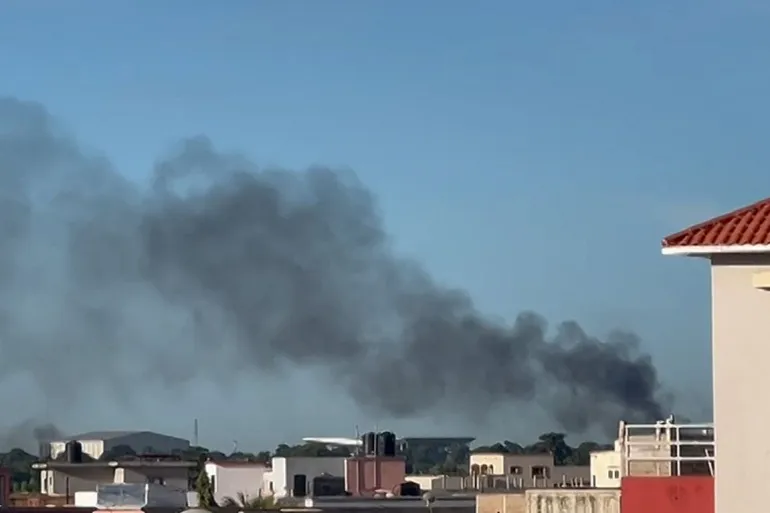
A major armed attack in Mali’s capital left an estimated 77 people dead and around 200 injured, exposing the continuing security challenges facing the country’s military government
BAMAKO: Mali’s capital Bamako has witnessed one of its deadliest attacks in years, with an estimated 77 people reportedly killed and about 200 others injured after armed fighters launched a coordinated assault on military installations in the city.
The attack, which took place on Tuesday, September 17, caused widespread panic in Bamako. Residents reported hearing gunfire and explosions, while smoke could be seen rising from several locations. Hospitals were reportedly overwhelmed as injured people were brought in for treatment.
The casualty figure was reported by AFP, citing sources familiar with the situation. The exact number of people killed and injured remained difficult to independently verify at the time.
The assault is particularly significant because Bamako has largely remained removed from the worst of the violence that has affected northern and central Mali for more than a decade.
The attack also represents the most serious assault on the capital since 2015, when armed groups carried out attacks targeting foreigners at a nightclub and the Radisson Blu Hotel.
Military installations targeted in Bamako
According to Malian authorities, armed fighters targeted an elite military police training facility in the Faladie district as well as a military base located near the airport.
The fighting reportedly lasted for several hours. Gunfire could be heard in parts of the capital, while fires and thick smoke were seen rising from buildings and infrastructure.
The authorities later said that the military had regained control of the situation and that the attack had been repelled. However, officials acknowledged that members of the Malian security forces had suffered casualties.
Mali’s military government also closed Modibo Keita International Airport following the attack.
State television ORTM later broadcast images of around 20 people who were described as suspects captured by the military. The individuals were shown blindfolded and with their hands tied.
Army Chief of General Staff Oumar Diarra said that security forces were continuing their search and operations in the affected areas.
Al-Qaeda-linked group claims responsibility
The al-Qaeda-linked Jama’at Nusrat al-Islam wal-Muslimin, commonly known as JNIM, claimed responsibility for the assault.
JNIM is one of the most powerful armed groups operating across the Sahel. It has established a significant presence in Mali and has also carried out attacks in neighbouring Burkina Faso and Niger.
The group has opposed Western military and political influence in the region and has called for the removal of what it describes as foreign “occupiers”.
JNIM said that its fighters had inflicted significant casualties on Malian forces and Russian fighters supporting the military government.
The group also released videos purporting to show parts of the attack. The footage reportedly showed fighters setting fire to an aircraft and attacking infrastructure at or near the airport.
One of the damaged aircraft belonged to the World Food Programme. The WFP confirmed that the aircraft was on the ground and did not have any personnel on board when it was damaged.
WFP spokesperson Djaounsede Madjiangar said the aircraft had been used to transport aid workers and provide emergency humanitarian assistance in remote parts of Mali.
The damage is expected to make an already difficult humanitarian situation even more challenging by reducing the organisation’s ability to reach vulnerable communities.
UN and international community condemn attack
The attack drew condemnation from the international community.
UN Secretary-General Antonio Guterres denounced the violence and confirmed that a UN staff member had been injured.
The African Union, Senegal, France and the United Kingdom also condemned the attack.
The incident has raised fresh concerns about the ability of Mali’s military government and its security partners to protect even the country’s political and military centre.
Why the Bamako attack is so significant
The location of the attack is one of the reasons it has attracted so much attention.
For years, most of Mali’s armed-group violence has been concentrated in the northern and central regions of the country, hundreds of kilometres from Bamako.
The capital had generally been considered considerably safer than many other parts of the country.
That makes an attack on military installations in Bamako particularly important. Rather than targeting a remote military outpost, the attackers managed to strike facilities close to the country’s main airport and within the capital itself.
The incident also comes at a sensitive time for Mali, which has undergone major political and military changes since the 2020 coup that brought Colonel Assimi Goita and other military leaders to power.
Bamako’s last major attacks were in 2015
The last major attacks in Bamako occurred in 2015.
In March that year, gunmen attacked a nightclub popular with foreigners, killing five people and injuring nine others.
Later that year, in November, the Radisson Blu Hotel was attacked. Twenty people were killed in that assault.
Those attacks were carried out by al-Mourabitoun, an armed group that later became part of the network that formed JNIM.
Since then, much of the violence linked to armed groups has shifted towards northern and central Mali and surrounding areas.
The latest assault, therefore, marks a worrying return of major militant violence to the capital.
Mali’s changing security strategy
Mali’s response to armed groups has changed dramatically over the past several years.
France, which had previously been one of Bamako’s most important military partners, deployed thousands of troops to Mali in 2013 to support the government against armed groups.
The United Nations also operated a major peacekeeping mission, known as MINUSMA, in the country.
While these forces helped the Malian government regain control of territory, violence continued, and public frustration with the security situation grew.
A military coup in 2020 brought Colonel Assimi Goita and his allies to power. The military government subsequently moved away from its former Western partners.
French troops began withdrawing from Mali in 2022, while the UN peacekeeping mission also eventually left the country.
The military government instead strengthened its relationship with Russia and brought in Russian fighters associated with the Wagner Group, now operating under the Africa Corps structure.
Reports have estimated that thousands of Russian personnel have been involved in supporting Mali’s security forces.
Russian support has not ended the insurgency
The arrival of Russian forces was presented by Mali’s military leadership as part of a strategy to regain territory and confront armed groups more aggressively.
Malian forces and their Russian partners have managed to make some territorial gains, particularly in the north.
However, the broader insurgency has continued.
Rights groups and international observers have also accused Malian and Russian forces of serious human rights violations during military operations, allegations that have added to international concern over the country’s security strategy.
The latest attack demonstrates that despite military offensives and foreign support, armed groups retain the ability to conduct complex operations.
Earlier losses for Malian and Russian forces
The Bamako assault also came only weeks after another major setback for Mali’s military and its Russian allies.
In July, Tuareg fighters in northern Mali launched a major ambush near Tinzaouaten.
Tuareg groups are separate from JNIM and the Islamic State affiliate in the region. Many Tuareg factions have historically demanded greater autonomy or independence for northern Mali, an area they refer to as Azawad.
Rebel sources claimed that dozens of Malian soldiers and Russian fighters were killed in the attack. Malian authorities did not confirm the full casualty figures but acknowledged that the army had suffered significant losses and lost a helicopter.
The incident highlighted the complexity of Mali’s security crisis, where the government is simultaneously dealing with jihadist groups, separatist movements and other armed factions.
Violence continues across the Sahel
The crisis in Mali cannot be viewed in isolation.
Neighbouring Burkina Faso and Niger have also experienced severe insecurity involving armed groups.
All three countries have been governed by military leaders following coups in recent years. Their governments have increasingly rejected traditional Western military partnerships and sought closer security cooperation with Russia.
Mali, Burkina Faso and Niger have also moved away from the Economic Community of West African States, or ECOWAS, and established the Alliance of Sahel States.
The three governments have promised to cooperate more closely in combating armed groups.
Despite those efforts, violence across the region has continued to increase.
Conflict monitoring organisations have recorded a sharp rise in attacks across Mali, Burkina Faso and Niger in recent years, with thousands of civilians killed.
Burkina Faso has been particularly badly affected, with large areas of the country reportedly under the influence or control of armed groups.
A growing humanitarian challenge
The continuing violence has consequences far beyond military casualties.
Millions of people across the Sahel have been affected by insecurity, displacement, food shortages and restricted access to basic services.
Humanitarian organisations depend heavily on aircraft and secure transport routes to reach isolated communities.
Damage to a World Food Programme aircraft in Bamako therefore carries significance beyond the immediate attack. Any disruption to humanitarian operations can make it harder to deliver food, medical assistance and emergency supplies to people living in conflict-affected areas.
The attack also risks worsening public fears in Bamako, where residents have generally viewed the capital as safer than the conflict zones farther north and east.
What happens next?
The Bamako attack is likely to put further pressure on Mali’s military government to demonstrate that its security strategy is working.
The government has relied heavily on military operations and partnerships with Russia while distancing itself from France and other Western powers.
But the ability of an armed group to launch a major assault in the capital suggests that significant security vulnerabilities remain.
For Mali, the challenge is now not simply to regain territory but to prevent armed groups from expanding their reach into areas previously considered relatively secure.
The attack also highlights the wider instability across the Sahel, where military governments are attempting to tackle entrenched armed movements while reshaping their international alliances.
For civilians, however, the immediate concern remains the same: whether the authorities can provide lasting security and prevent further attacks.
The Bamako assault has shown that, despite years of military campaigns and changing foreign partnerships, the conflict in Mali remains far from over.
News source: Information for this article was gathered from a variety of reliable news outlets.