Trump’s Secret Plane Switch in Turkey Leaves Reporters Angry and Uncomfortable
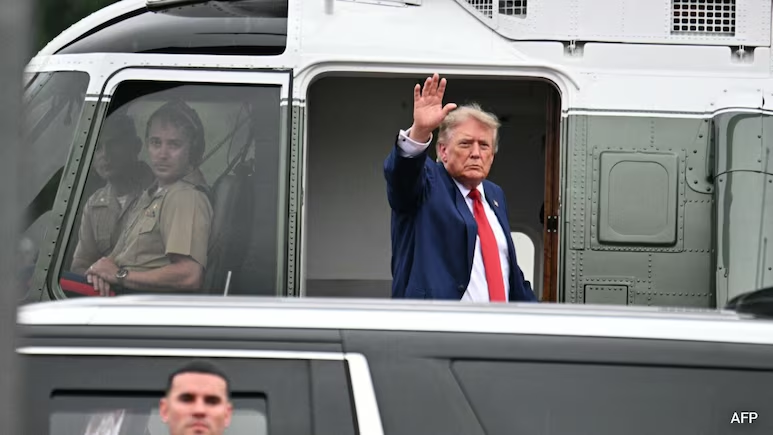
Turkey : A secret security operation involving US President Donald Trump has sparked anger among journalists after a group of reporters travelling with him reportedly discovered only later that they had unknowingly been used as decoys during his departure from Turkey.
According to a report by The Washington Post, Trump secretly left Air Force One while the aircraft was on the ground in Turkey on July 8. His security team reportedly arranged the covert move after receiving what a US official described as a credible threat from Iran.
The unusual operation involved Trump leaving the presidential aircraft and transferring to a smaller US Air Force plane nearby. The move was reportedly carried out in a way that kept his actual departure from being immediately obvious.
What has particularly upset some journalists, however, is that around a dozen members of the travelling media were left on Air Force One. They continued their journey without knowing that the president was no longer on board. The aircraft subsequently departed Turkey with journalists and staff still inside.
For some reporters, the issue was not simply that the White House had kept Trump’s movements secret. They were concerned that they had unknowingly been placed in a potentially dangerous situation.
One White House reporter, speaking anonymously to The Washington Post, questioned why journalists should be expected to take risks connected to protecting the president.
The reporter argued that journalists accept risks as part of covering the president but said protecting the president from an assassination attempt is not part of their professional responsibility.
Why the flight became controversial
The secrecy surrounding Trump’s departure came amid heightened tensions between the United States and Iran. According to the report, American officials believed there was a credible threat against the president.
Journalists travelling on the presidential plane reportedly noticed unusual security measures. Among them was an instruction from the Secret Service requiring passengers to keep the aircraft’s window shades lowered during takeoff.
Such instructions are unusual during ordinary presidential travel and raised questions among members of the travelling press.
Trump’s Turkey trip had already attracted attention because he initially travelled on a luxury Boeing 747 provided by Qatar. The aircraft had been retrofitted for presidential use, but reportedly did not have the same anti-missile protection associated with the traditional Air Force One.
Because of the security concerns, the older Air Force One aircraft was reportedly brought into the operation.
At the time, Trump suggested that the aircraft being sent ahead had another purpose. He said it was intended for US troops in Britain to tour as a special treat.
However, during a stop in Britain, Trump reportedly returned to the Qatar-provided aircraft for the flight back toward Washington.
When reporters previously asked about the unusual instruction to keep the window shades down, Trump acknowledged that the journey could be dangerous because of threats facing the United States.
Reporters say they were kept in the dark
The biggest frustration among some members of the travelling press was that they were not informed about the plane switch.
Journalists covering the president are accustomed to security restrictions and last-minute changes to presidential schedules. However, some argued that being deliberately kept aboard an aircraft that could potentially be targeted was a different matter.
The reporters had boarded Air Force One expecting to travel with the president. Instead, Trump had already been moved to another aircraft before the plane took off.
This meant that the journalists unknowingly remained aboard what could have been mistaken by an attacker as the president’s aircraft.
For reporters, the situation raised questions about where the line should be drawn between presidential security and the safety of the media travelling with the president.
White House defends security measures
The White House has not directly addressed all the details surrounding the alleged plane switch.
White House Communications Director Steven Cheung defended the administration’s approach, saying that numerous threats exist against the president and that the government uses every available method to protect him.
The comments suggest that officials viewed the secrecy surrounding Trump’s movements as necessary to protect him from potential attacks.
Presidential security teams routinely use deception and secrecy when there is a serious threat. Keeping a president’s movements confidential can make it harder for potential attackers to predict where and when the president will travel.
However, the incident has highlighted the difficult balance between protecting the president and ensuring that members of the press travelling alongside him are not unknowingly exposed to additional danger.
Secret presidential travel is not unprecedented
Although the Turkey operation has generated criticism, secret changes in presidential travel arrangements are not entirely new.
Former President Bill Clinton reportedly switched presidential aircraft during a 2000 trip involving India and Pakistan. A decoy aircraft carrying Secret Service personnel was reportedly used as part of the security arrangements.
Former President Joe Biden’s 2023 visit to Ukraine was also kept highly secret because of the security risks involved. His journey involved a long and carefully coordinated trip by plane and train, although a reporter and photographer travelled with him.
The difference in Trump’s case, according to critics, is that a significant group of journalists apparently remained aboard the aircraft without knowing that the president had already left.
A security measure that raised bigger questions
The episode has therefore become more than a story about a secret presidential flight.
For Trump’s security team, secretly moving the president away from an aircraft may have been an important precaution in response to a serious threat.
For journalists, however, the incident has raised concerns about transparency, professional responsibility and their own safety while covering the president.
The controversy also shows the complicated nature of presidential travel during periods of international conflict. Security officials may need to make decisions within seconds and keep information tightly controlled. At the same time, journalists travelling with the president need enough information to understand risks that could directly affect them.
The White House has maintained that protecting the president requires the use of every available security measure. But for some members of the travelling press, the Turkey incident has left an uncomfortable question: How much risk should journalists be expected to unknowingly accept while doing their jobs?
News source: Information for this article was gathered from a variety of reliable news outlets.