Chidambaram Questions BRICS Benefits for India as BJP Hits Back
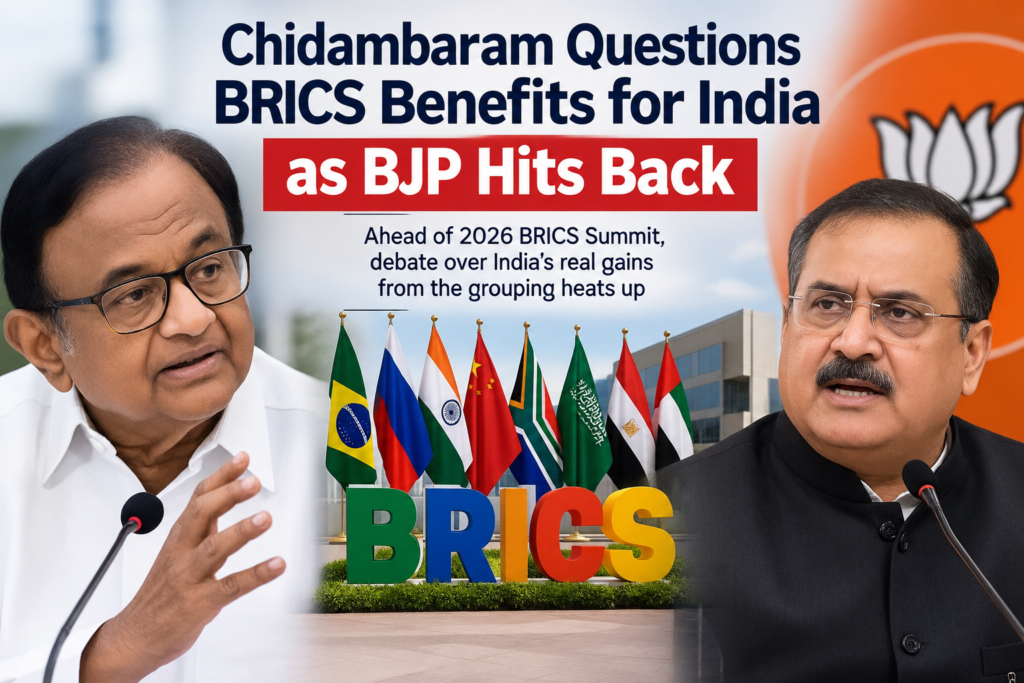
As India prepares to host the 2026 BRICS Summit in New Delhi, senior Congress leader P. Chidambaram has questioned whether recent BRICS meetings have delivered meaningful benefits for the country, prompting a sharp response from the BJP.
New Delhi: With the national capital gearing up to host the BRICS Summit 2026, a political debate has emerged over what India has actually gained from its participation in major international groupings.
Senior Congress leader and Rajya Sabha MP P. Chidambaram has raised questions about the practical outcomes of recent BRICS summits. Speaking ahead of the high-profile gathering in Delhi, the former Union minister said he had not seen significant or tangible results for India from the last two or three BRICS meetings.
Chidambaram pointed out that India is part of several important international groupings, including BRICS, the Shanghai Cooperation Organisation (SCO), the G20 and the QUAD. While these platforms give India an opportunity to engage with major countries and influence global discussions, he questioned what concrete advantages the country has received from them in recent years.
According to Chidambaram, earlier BRICS summits had produced some tangible outcomes, but he felt that the more recent meetings had not delivered similar results. His comments came just days before India is scheduled to host the BRICS Summit in New Delhi on September 12 and 13.
The remarks quickly drew criticism from the BJP. Senior BJP leader Nalin Kohli questioned the Congress’s broader understanding of diplomacy and whether international relations should be judged mainly through immediate, measurable gains.
Kohli also accused the Congress of trying to turn an important international event into a political issue. He questioned whether asking for “tangible benefits” reflected a narrow approach to diplomacy, where every international engagement is viewed primarily through a direct give-and-take lens.
The exchange comes at a significant moment for India. The country assumed the BRICS Chairship on January 1, 2026, with the theme “Building for Resilience, Innovation, Cooperation and Sustainability.” The upcoming summit is therefore an important opportunity for India to shape discussions within the grouping and strengthen its engagement with emerging and developing economies.
BRICS currently consists of 11 countries: Brazil, China, Egypt, Ethiopia, Indonesia, India, Iran, Russia, Saudi Arabia, South Africa and the United Arab Emirates. The grouping has grown considerably in recent years and now represents around 49 per cent of the world’s population and approximately 40 per cent of global GDP.
Several major leaders are expected to attend the New Delhi summit, including Chinese President Xi Jinping, Iranian President Masoud Pezeshkian, Russian President Vladimir Putin, South African President Cyril Ramaphosa and Indonesian President Prabowo Subianto.
As preparations continue across Delhi, the political disagreement over BRICS highlights two different ways of looking at India’s international engagement. While Chidambaram is questioning the visible and practical gains from recent summits, the BJP argues that diplomacy cannot always be measured only in terms of immediate benefits.
With India hosting the summit this year, the focus will now be on what outcomes emerge from the meeting and whether the gathering can produce concrete initiatives that strengthen India’s economic, strategic and diplomatic interests.
News source: Information for this article was gathered from a variety of reliable news outlets.