Stalin Hits Back at Vijay Over Assembly Gesture Row: “You’re Running the Administration Like a Cinema Shooting”
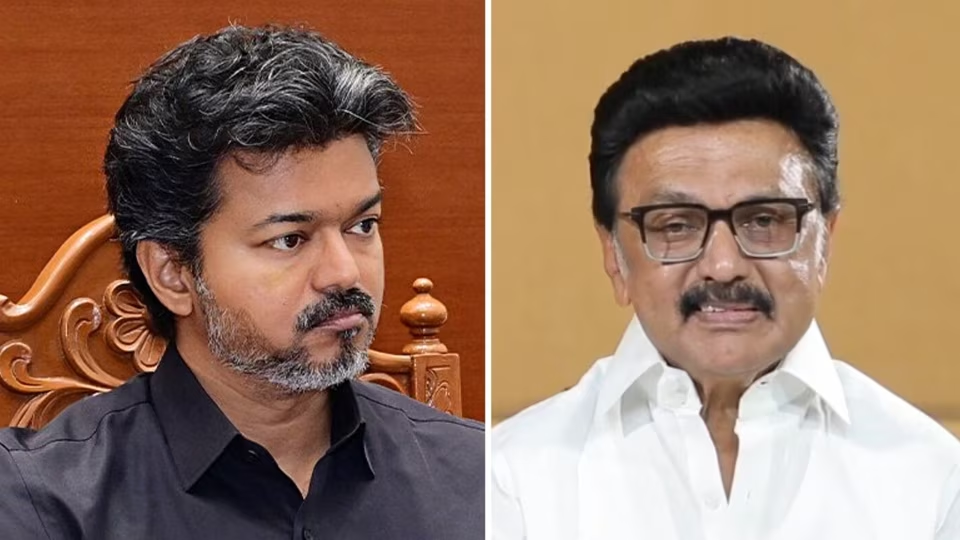
DMK chief MK Stalin responds sharply to Tamil Nadu Chief Minister Vijay after the Assembly gesture controversy, recalling his Emergency-era arrest and accusing the actor-turned-politician of using reels and publicity to divert attention from governance.
The political rivalry in Tamil Nadu has taken another sharp turn, with DMK president and former chief minister MK Stalin hitting back at Chief Minister C Joseph Vijay over a recent controversy in the state Assembly.
Stalin criticised Vijay for bringing what he described as unnecessary controversies into the Assembly and accused the chief minister of treating the House and administration more like a film set than a platform for serious public issues.
His remarks came two days after Vijay clarified that a hand gesture he made while referring to the Maintenance of Internal Security Act (MISA) during an Assembly discussion was “not in any way intentional”.
The gesture, in which Vijay placed his hand near his jaw, was widely interpreted as a reference to injuries Stalin suffered during his detention under MISA during the Emergency in the 1970s.
Stalin: “History cannot be changed”
Addressing Vijay as “Thambi Vijay”, meaning younger brother Vijay, Stalin said the Emergency period and the DMK’s resistance during that time were important parts of the party’s political history.
Stalin argued that these events should not be treated casually or used as political talking points without understanding their historical context.
He said the experiences of those who were detained during the Emergency had left a lasting mark on the DMK and on his own political life.
Taking a direct swipe at Vijay, Stalin accused him of turning the Assembly into a platform for publicity.
He alleged that Vijay was using reels and photo opportunities to create political attention while standing on infrastructure created by previous governments.
Stalin further claimed that the administration was being handled in a manner similar to a film production and alleged that social media content was being used to divert attention from what he described as shortcomings in governance.
Vijay had earlier clarified his Assembly gesture
The controversy began after Vijay referred to MISA during an Assembly discussion and made a hand movement near his jaw.
The gesture quickly became a subject of political debate, with critics interpreting it as a reference to Stalin’s alleged injuries during his detention under the Emergency.
Vijay later clarified that the gesture had not been intentional.
However, Stalin’s latest response indicates that the controversy has not ended.
Instead, he has used the opportunity to recount his own experience during the Emergency and remind the public of the political history surrounding his imprisonment.
Stalin recalls his arrest during the Emergency
Stalin said the DMK had organised a major gathering at Chennai’s Marina Beach in 1976 to oppose the Emergency and criticise the use of MISA.
According to Stalin, the political situation became more serious after the Union government dismissed the DMK government on January 31, 1976.
He recalled that police subsequently went to the residence of former Tamil Nadu chief minister and DMK patriarch M Karunanidhi in Gopalapuram to arrest him under MISA.
Stalin said he was not at home at the time because he had gone out for campaigning.
According to his account, Karunanidhi informed the police that his son was away and would return the following day. Stalin said Karunanidhi then asked the police to return and arrest him once he came back.
Stalin recalled that when he returned home, his father himself called the police and asked them to take him into custody.
“My jaw was broken”
Stalin also spoke emotionally about what he said happened during his imprisonment.
He recalled being detained under MISA and alleged that prisoners were kept in poor and unhygienic conditions.
He further alleged that detainees were subjected to repeated physical assaults.
Stalin said he suffered a serious injury to his jaw during the alleged beatings and continues to carry scars from that period.
His account also referred to veteran DMK leader and former Madras mayor Chitti Babu, who died after being beaten while in prison.
Stalin has previously stated that Chitti Babu suffered blows that were intended for him during the period of incarceration.
Referring directly to Vijay’s controversial gesture, Stalin said the hand movement near the jaw reminded him of the injury he suffered during that difficult period.
For Stalin, therefore, the gesture was not simply a political joke or an ordinary Assembly moment. He presented it as something connected to a painful chapter of his personal and political history.
“I am proud to be part of DMK history”
Stalin also connected his Emergency-era experience with the broader ideological history of the DMK.
He said the party’s political struggles went back to its early leadership, including founder CN Annadurai, popularly known as Perarignar Anna.
Stalin argued that his imprisonment formed part of that larger history of political resistance and sacrifice.
He challenged Vijay to examine official records and historical accounts before making statements about his past.
According to Stalin, understanding the history behind the DMK’s Emergency-era struggle would provide a clearer picture of what happened to him and other party leaders.
Stalin also responds to Sarkaria Commission allegations
The political exchange did not stop with the MISA controversy.
Stalin also responded to Vijay’s references to the Sarkaria Commission and allegations of corruption involving the DMK government led by Karunanidhi.
Vijay had earlier referred to the commission while raising allegations relating to corruption, tenders and alleged commissions during the previous DMK administration.
Stalin questioned why, if the allegations were serious and supported by evidence, successive governments at both the Centre and in Tamil Nadu had not taken decisive action over the years.
He accused Vijay of repeating allegations against Karunanidhi for political reasons and described the approach as an attempt to target the DMK’s political legacy.
ED allegations also become part of the political clash
Stalin also criticised Vijay’s reference to an Enforcement Directorate letter while discussing alleged corruption involving DMK leaders.
The DMK leader claimed that many cases investigated by the agency had not ultimately resulted in convictions and accused the central agency of being used for political purposes.
These claims are part of the wider political battle between the DMK and its opponents, with corruption allegations and investigations frequently becoming major points of contention.
Stalin says Assembly should focus on people’s issues
Despite the increasingly personal nature of the exchange, Stalin argued that the Tamil Nadu Assembly should remain focused on issues affecting ordinary people.
He said the House should be used to discuss law and order, welfare schemes, Tamil Nadu’s rights and the state’s development rather than becoming a stage for political theatrics.
His message to Vijay was direct: avoid unnecessary controversies inside the Assembly and concentrate on governance.
Stalin also recalled that Vijay had visited his residence after becoming chief minister.
According to Stalin, Vijay had acknowledged that he had made critical comments about Stalin during the election campaign and had apologised for them.
Stalin said he had accepted the apology and told Vijay that he did not hold such remarks against him personally.
A growing political rivalry in Tamil Nadu
The latest exchange highlights the increasingly competitive political atmosphere in Tamil Nadu, where Vijay’s entry into electoral politics has added another major player to an already crowded political landscape.
As an actor-turned-politician, Vijay brings enormous public recognition and a strong social-media presence, while the DMK has a long-established political organisation and history in the state.
The clash over the MISA gesture is therefore about more than a single hand movement. It has opened a wider debate over political history, governance, public image and the changing nature of Tamil Nadu politics.
For Stalin, the controversy offered an opportunity to remind voters of the struggles associated with the DMK’s past.
For Vijay, the incident underscores the challenges of moving from the world of cinema into the highly scrutinised environment of electoral politics, where even a brief gesture inside the Assembly can trigger a major political confrontation.
With both sides continuing to trade sharp remarks, the latest dispute is unlikely to be the last chapter in the growing political contest in Tamil Nadu.
News source: Information for this article was gathered from a variety of reliable news outlets.