Trump Says “No Limits” to His Power as US-Iran Deal Sparks Global Debate
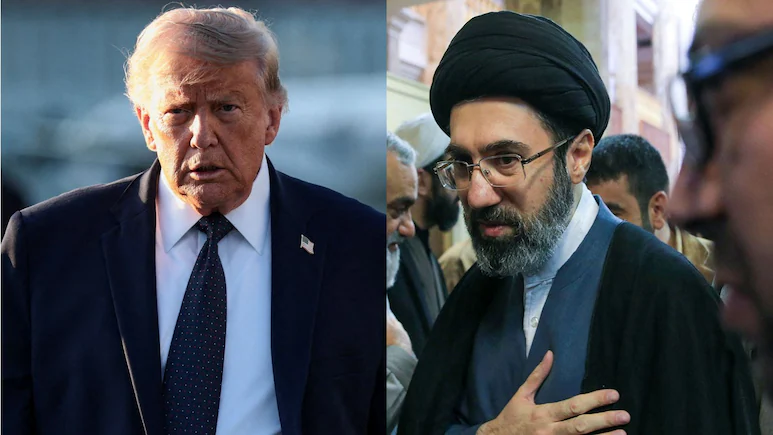
Delhi . June 19 : . In a bold and controversial statement, Donald Trump has said he believes there are “no limits” to his power, following the signing of a major agreement with Iran aimed at ending the three-month-long conflict between the two nations.
The statement came after Trump and Iranian President Masoud Pezeshkian signed a memorandum of understanding (MoU), which could potentially reshape the political and economic future of the Middle East. The war, which began earlier this year, had triggered global fears over oil shortages, economic instability, and rising tensions in the region.
Speaking to media after the agreement, Trump insisted that the deal was not a sign of weakness or compromise but a calculated decision to avoid a worldwide depression. He claimed that continuing the war would have pushed the global economy into deeper crisis, especially with the blockade of the crucial Strait of Hormuz.
Trump said the US had imposed a powerful naval blockade during the conflict, stopping ships from entering and exiting Iranian ports. According to him, this military pressure forced Iran into negotiations and showed the strength of American power. He described the deal as a result of his leadership and suggested that only he could have handled the situation this way.
Despite his strong claims, the agreement has raised serious concerns among political analysts and international observers. While Iran has promised that it will not develop nuclear weapons, the deal reportedly lacks any clear mechanism for verification or enforcement. This has created uncertainty about whether Iran’s nuclear ambitions will truly be curbed.
The agreement also marks a major shift in US policy. In exchange for Iran’s commitment, Washington has agreed to immediately lift sanctions on Iranian oil exports, giving Tehran access to global markets once again. This move is expected to provide significant economic relief to Iran, whose economy has been heavily damaged by years of sanctions and war.
Another major development is the reopening of the Strait of Hormuz, one of the world’s most important oil routes. The waterway had been blocked during the war, disrupting the movement of millions of barrels of oil. With the blockade now lifted, oil tankers have resumed movement, bringing some relief to global energy markets.
However, experts warn that normal shipping operations may take time to fully recover. Hundreds of vessels are still waiting to exit the Persian Gulf, and alternative routes do not have the same capacity as the central Hormuz passage.
Meanwhile, the future of the deal remains uncertain. US Vice President JD Vance postponed his planned visit to Switzerland, where follow-up talks on the agreement were expected. This has raised speculation about possible disagreements or delays in the next phase of negotiations.
From Iran’s side, Supreme Leader Mojtaba Khamenei has expressed caution. While he acknowledged that future face-to-face talks with the US could happen, he made it clear that Iran would not simply accept American demands without resistance.
The agreement also includes a proposed $300 billion reconstruction fund for Iran, supported by regional allies, to rebuild infrastructure damaged during the conflict. Additionally, there are plans for the International Atomic Energy Agency to inspect Iran’s nuclear facilities and assess the status of its enriched uranium stockpile.
Critics of the deal argue that it gives Iran too much without enough guarantees in return. They point out that the memorandum does not address Iran’s missile program, proxy groups, or military expansion — all major concerns for the US and its allies.
Supporters, however, believe the agreement could be the first step toward long-term peace and stability in the region. They argue that ending the war and reopening global oil routes was necessary to prevent further economic damage.
For now, the world is watching closely. Whether this agreement becomes a turning point for peace or simply a temporary pause in hostilities will depend on what happens in the coming weeks. But one thing is clear — Trump’s latest remarks and actions have once again placed him at the center of global attention.
News source: Information for this article was gathered from a variety of reliable news outlets.