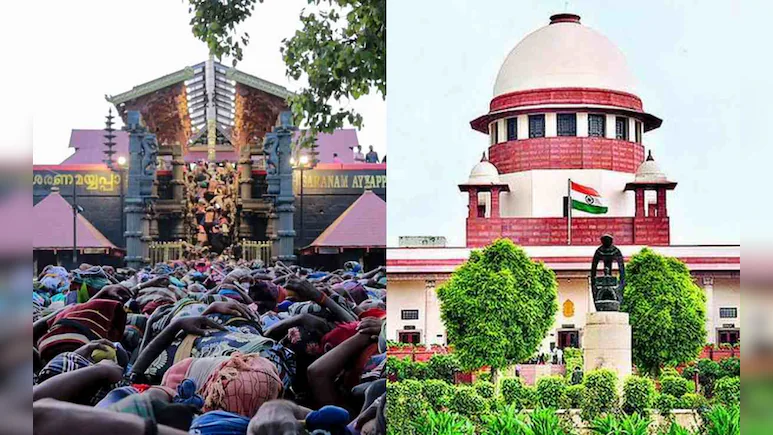
Supreme Court of India’s 9-Judge Bench Takes Up Sabarimala Questions A Defining Moment for Women’s Rights and Religious Freedom
At first glance, the ongoing hearings in the Supreme Court of India may seem like a continuation of the long-running Sabarimala Temple controversy. But what is unfolding inside the courtroom goes far deeper—it is a moment that could redefine how India balances faith and fundamental rights.
A nine-judge bench is currently examining seven crucial constitutional questions. These questions may not explicitly mention women, but their impact on women’s rights could be profound. At stake is a fundamental issue: can religious traditions override the principles of equality, dignity, and individual freedom guaranteed by the Constitution?
For many women across India, this is not just a legal debate—it is deeply personal. From temple entry restrictions to practices within different communities, the question remains whether faith can be used to justify exclusion or discrimination.
Historically, India has seen this tension play out multiple times. Landmark cases like Shah Bano case and Shayara Bano case forced the courts to confront the “woman question” directly. Each time, the judiciary had to decide whether long-standing customs could stand against constitutional guarantees of equality.
The Sabarimala verdict in 2018, which allowed women of all ages to enter the temple, was another such turning point. Yet, the resistance it triggered showed how deeply rooted these issues are in society.
Now, the court is not just revisiting that decision—it is attempting to draw clearer boundaries. How far does religious freedom extend? Can communities claim autonomy if their practices conflict with basic rights? And most importantly, do women have equal rights within religious spaces, or are those rights limited?
These questions ripple beyond one temple or one community. They touch on issues like practices within the Dawoodi Bohra community, the rights of Parsi women who marry outside their faith, and broader concerns within personal laws across religions.
In everyday life, women have made remarkable progress—in education, careers, and public leadership. Yet, within many religious and social structures, inequality still lingers quietly. The courtroom now becomes the place where these contradictions are being confronted head-on.
The outcome of this hearing will not just settle a legal debate—it will shape the future. It will determine whether constitutional morality can challenge centuries-old traditions, or whether those traditions will continue to define the limits of equality.
For millions watching, this is more than a case. It is about the kind of society India chooses to be—one where rights evolve with time, or one where they remain bound by tradition.
News Source : Information for this article was gathered from a variety of reliable news outlets.