Ambani’s Succession Plans Face a New Challenge as Vantara Wildlife Controversy Grows
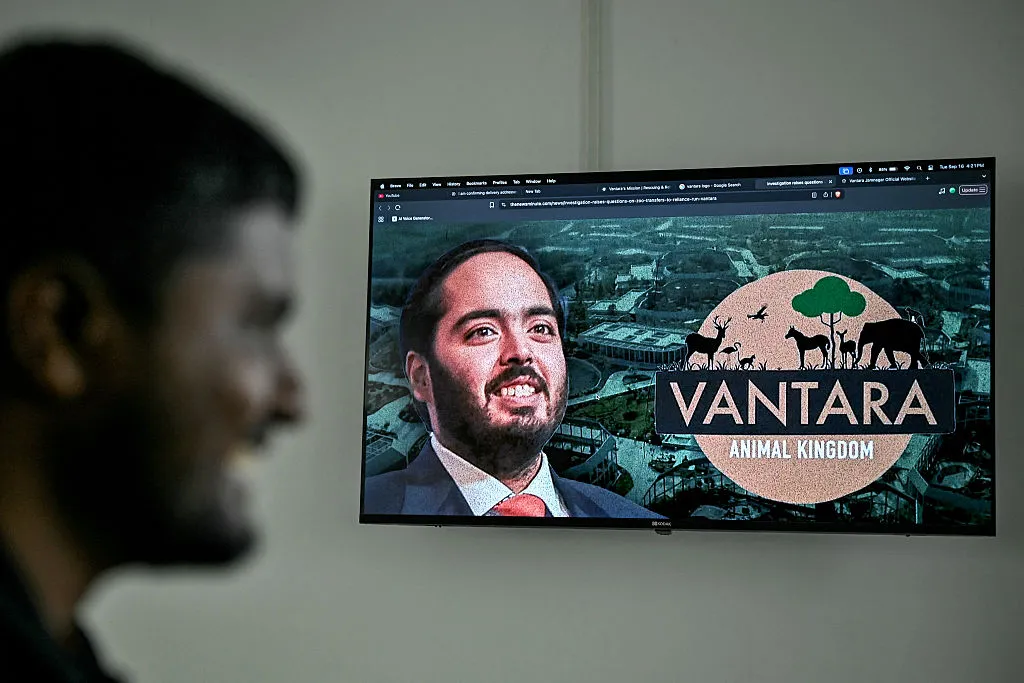
Mumbai : Mukesh Ambani’s carefully planned succession strategy at Reliance Industries is facing an unexpected complication — not from business competition or family disagreements, but from growing questions surrounding the wildlife sanctuary associated with his youngest son, Anant Ambani.
Vantara, the ambitious animal rescue and rehabilitation centre established in Jamnagar, Gujarat, was initially presented as a major conservation initiative. Spread across thousands of acres, the facility was designed to rescue, treat and rehabilitate animals from difficult circumstances. Over time, however, it has attracted increasing international attention and scrutiny over how some animals were acquired and whether the movement of certain exotic and endangered species could inadvertently contribute to the global wildlife trade.
The controversy has now prompted Vantara to change its approach to acquiring animals. In a significant policy shift, the organisation has announced that future acquisitions will undergo a three-stage screening process. It has also committed to not importing great apes, big cats or species facing extinction directly from their natural habitats.
The change could help reduce the reputational pressure surrounding Anant Ambani’s wildlife project. At the same time, it has broader significance for Reliance Industries because Anant is no longer simply a member of the Ambani family pursuing a personal passion. Since his appointment as an executive director of Reliance Industries in 2025, his public image has increasingly become connected with the future leadership of one of India’s largest corporate groups.
From a passion project to a global talking point
Vantara became widely known during the elaborate pre-wedding celebrations of Anant Ambani and Radhika Merchant. The celebrations brought together some of the world’s most influential business leaders, celebrities and political figures, while the Jamnagar facility offered guests a glimpse into Anant’s long-standing interest in animal welfare.
The sanctuary, described as a centre for rescue, treatment and rehabilitation, houses a huge variety of animals. Its scale and ambition helped establish Vantara as one of the most prominent private wildlife initiatives in India.
For the Ambani family, the project also reflected Anant’s personal interests. But its rapid growth brought greater public attention. As the number and diversity of animals at the facility increased, questions began to emerge among conservationists and environmental groups about where some of the animals came from and whether all acquisitions were consistent with international conservation principles.
Reports from international publications raised allegations that some animals described as rescued may have been sourced from the wild. Vantara’s foundation rejected those allegations and maintained that the accusations were baseless.
The controversy nevertheless refused to disappear.
Why the issue matters to Reliance
Under ordinary circumstances, controversy surrounding a private wildlife project might remain largely separate from a family-controlled conglomerate.
But the circumstances surrounding Vantara are different.
Anant Ambani has become increasingly involved in Reliance Industries, making his public reputation more important to the company’s long-term succession story. Mukesh Ambani has been gradually preparing his three children — Akash, Isha and Anant — for larger responsibilities across different parts of the business empire.
Akash Ambani has been associated closely with Reliance’s telecommunications operations, while Isha Ambani has played a major role in the group’s retail business. Anant, meanwhile, has been linked to Reliance’s traditional energy businesses as well as its ambitious plans in new energy.
This makes Anant’s position particularly important.
Reliance’s oil-to-chemicals operations remain a major source of cash for the group, while its investments in new energy require enormous amounts of capital. These businesses will operate in highly competitive markets, including areas where other major Indian conglomerates are aggressively expanding.
As a result, investors are likely to pay close attention not only to the financial performance of the businesses but also to the credibility and reputation of the executives expected to lead them.
Vantara’s new approach
The recent decision by Vantara represents a notable change in direction.
In a letter sent to India’s CITES management authority under the environment ministry, the organisation said it did not want to become, even unintentionally, a contributor to illegal wildlife trade.
The new framework means that future animal acquisitions will be subjected to multiple levels of scrutiny before they are approved.
The organisation has also ruled out importing great apes, big cats and species threatened with extinction from their natural habitats.
That is an important distinction because the debate surrounding wildlife conservation is no longer limited to whether an animal is legally acquired.
Conservationists increasingly argue that even a legally permitted transfer can raise ethical concerns if removing an animal from its natural environment causes stress, disrupts ecosystems or encourages demand for wild-caught animals.
The Supreme Court has previously examined legal challenges concerning Vantara and, in 2025, upheld a clean chit from an investigation concerning the sanctuary’s animal acquisitions. Yet legal and conservation-related questions have continued to surface.
In another case in 2026, the Supreme Court declined to entertain a petition seeking restrictions on certain animal imports, while also highlighting concerns about the possibility of cruelty when animals are removed from their natural habitats.
For Vantara, the message was clear: legal compliance alone may not be sufficient to avoid reputational controversy.
A change from importing animals to protecting them where they live
Perhaps the most significant part of Vantara’s new strategy is the proposed emphasis on conservation in the animals’ native habitats.
Rather than bringing animals from around the world to Jamnagar, the organisation says it intends to increasingly support conservation projects closer to where the animals naturally live.
One example involves Colombia’s feral hippopotamus population.
The animals descend from hippopotamuses originally brought to the country by notorious drug trafficker Pablo Escobar. Their population has expanded considerably, creating an environmental and management challenge for Colombian authorities.
Earlier, Anant Ambani had reportedly sought permission to bring some of these animals to India. Under the newer approach, the emphasis could instead be on creating a sanctuary in Colombia itself and helping protect the animals there rather than transporting them to India.
Such a strategy could significantly change the public perception of Vantara.
Instead of being viewed primarily as a huge collection of exotic animals in India, the facility could increasingly position itself as an international conservation organisation supporting animals in their native ecosystems.
The bigger issue: Reliance’s succession
The wildlife controversy matters because it intersects with a much bigger question facing Reliance: who will eventually control and manage the empire built by Mukesh Ambani?
Mukesh Ambani has repeatedly emphasised that Reliance should remain united after his succession.
That ambition reflects the difficult history of the Ambani family itself. Mukesh and his younger brother Anil Ambani famously divided their business interests after their father Dhirubhai Ambani’s death.
The current generation appears determined to avoid a similar split.
Akash, Isha and Anant are being positioned to lead different parts of the business, but their responsibilities are ultimately expected to function within a unified Reliance structure.
For investors, therefore, the question is not simply whether each sibling can run an individual business.
The larger question is whether the next generation can collectively maintain the scale, discipline and global credibility that Reliance has achieved under Mukesh Ambani.
Investors will be watching closely
Reliance has attracted some of the world’s largest institutional and strategic investors.
Global companies and investment firms have put substantial capital into Reliance’s telecommunications and retail businesses. Jio Platforms has attracted major international investors, while the retail business has also received investments from prominent global financial institutions.
The possibility of future initial public offerings for these businesses makes corporate reputation even more important.
A successful IPO requires investors to have confidence in management, governance, financial performance and long-term strategy.
That means the personalities and public reputations of the next generation of Reliance leaders could become increasingly important.
A controversy involving a personal project may not directly affect the financial performance of Reliance’s businesses. However, if investors begin to view such controversies as indicators of management judgement or governance risks, the issue can become much more significant.
That is why Vantara’s recent policy shift could be seen as more than an environmental decision.
It is also a reputational risk-management exercise.
Anant’s challenge is particularly complicated
Among the three Ambani siblings, Anant arguably faces a different kind of challenge.
Akash and Isha have been closely associated with businesses that are directly connected to consumers and digital markets. Their leadership roles can be measured through subscriber growth, retail expansion, digital services and financial performance.
Anant’s responsibilities are tied more closely to the energy and industrial side of Reliance, where the company faces intense competition and enormous capital requirements.
Reliance’s expansion into new energy is particularly ambitious. The company is seeking to establish itself in industries that will shape the global transition away from fossil fuels.
That will require technological expertise, huge investments and the ability to compete with established international companies.
At the same time, Gautam Adani’s business empire has emerged as a major competitor across infrastructure and energy-related sectors.
For Anant, therefore, establishing credibility as a business leader will be crucial.
His association with Vantara can be an asset if the project is seen as a serious conservation initiative. But it can become a liability if continued controversy creates doubts about judgement or governance.
The lesson for the Ambani family
The latest development offers an important lesson for the Ambani succession strategy.
Running a global conglomerate is not only about owning businesses or appointing family members to senior positions.
It also requires building institutions that can withstand scrutiny from investors, regulators, employees, customers and international partners.
Mukesh Ambani has spent decades transforming Reliance from an Indian industrial company into a diversified global business spanning energy, telecommunications, retail, technology and new energy.
The challenge now is to ensure that this enormous organisation remains professionally managed when he eventually steps back.
That means the next generation must demonstrate that they can operate successfully within a sophisticated corporate structure rather than relying solely on the Ambani name.
Professional management could become increasingly important
For investors, the ideal succession scenario may not depend entirely on which sibling takes the most prominent position.
Instead, it could depend on whether Reliance creates a strong layer of professional executives capable of running the company regardless of the personal interests of its owners.
A powerful professional management team would provide continuity.
It would also reassure investors that the company’s businesses can continue operating effectively even if members of the next generation choose to focus on different personal interests.
That is especially important for a company as large and complex as Reliance.
The group operates across industries with very different regulatory environments, competitive pressures and capital requirements. Managing such a portfolio requires specialised expertise.
In that context, the Ambani children may ultimately function more effectively as strategic owners and leaders supported by experienced professional managers rather than attempting to personally oversee every aspect of the conglomerate.
Vantara’s future could therefore be very different
The wildlife sanctuary may now be entering a new chapter.
Its future could be less about acquiring animals from around the world and more about supporting conservation projects in the countries and ecosystems where those animals naturally belong.
If implemented effectively, the shift could help Vantara rebuild trust with conservationists and reduce criticism over wildlife sourcing.
It could also transform Anant Ambani’s personal passion into a broader conservation platform with international relevance.
The key will be transparency.
Clear documentation of where animals come from, how they are transported, why they require intervention and what conservation purpose the project serves could help reduce doubts.
For a facility of Vantara’s size and visibility, scrutiny is unlikely to disappear completely. But a more conservative and habitat-focused approach could substantially reduce the controversy surrounding it.
The road ahead for Reliance
The Ambani succession will ultimately be judged on much more than the future of a wildlife sanctuary.
Investors will want to know whether Reliance can remain united, whether the next generation can work together, whether the group’s major businesses can continue growing and whether professional managers will be given enough authority to maintain corporate discipline.
They will also be watching the performance of the telecommunications, retail, energy and new-energy businesses as leadership gradually transitions.
For Mukesh Ambani, the biggest challenge may therefore be ensuring that the transition is not merely about transferring control from one generation to the next.
It is about creating a structure in which the company can thrive regardless of individual personalities.
The Vantara controversy has highlighted that even a personal passion can become relevant to a corporate empire when the person behind it is part of the future leadership team.
By tightening its rules on animal acquisitions and shifting greater attention toward conservation in native habitats, Vantara appears to be acknowledging that reality.
For Anant Ambani, the change could provide an opportunity to demonstrate that his interest in wildlife can evolve from a personal passion into a disciplined and internationally credible conservation effort.
For Mukesh Ambani, meanwhile, it offers another reminder that succession planning involves much more than dividing responsibilities among his children.
The real test will be whether the next generation can earn the same level of trust from global investors, partners and business leaders that their father has built over decades.
And for Reliance, the ultimate goal remains clear: a smooth transition, a united family and a professionally managed empire capable of continuing its expansion long after Mukesh Ambani steps away from the centre of the stage.
News source: Information for this article was gathered from a variety of reliable news outlets.