Trump Family’s Crypto Bank Plan Raises Fresh Questions Over Conflicts of Interest
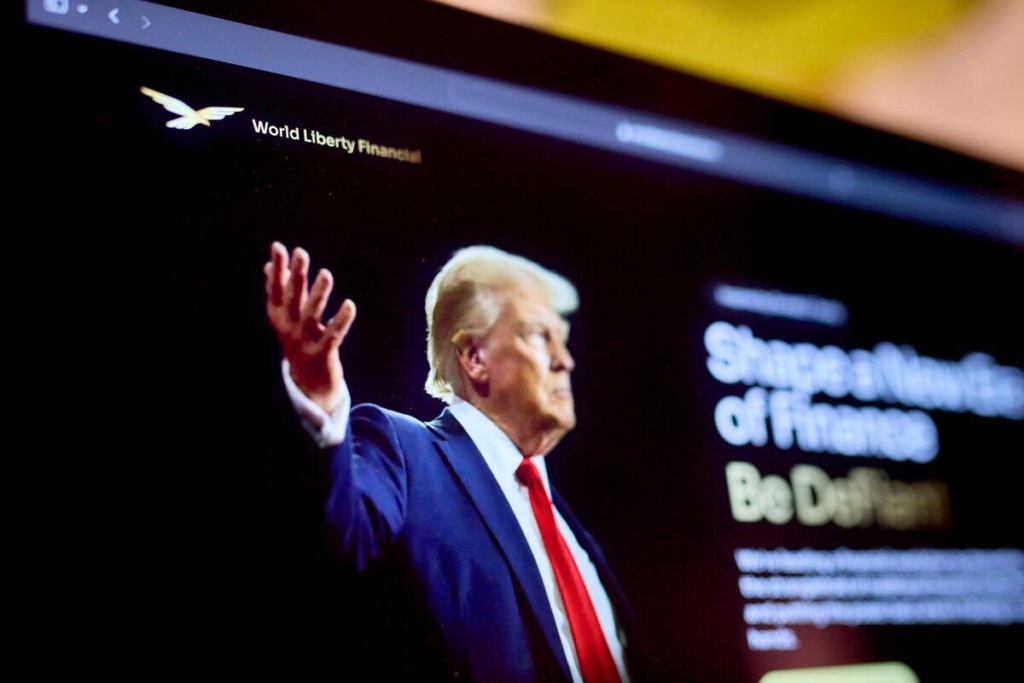
Washington : The Trump family’s growing presence in the cryptocurrency industry has taken a significant step forward, but the development is also triggering a new wave of concern in Washington over potential conflicts of interest.
World Liberty Financial, a cryptocurrency venture closely linked to President Donald Trump’s family, has received conditional approval from the U.S. Treasury Department’s Office of the Comptroller of the Currency (OCC) to operate as a federally chartered trust bank. The preliminary approval could give the company greater authority and credibility within the U.S. financial system while allowing it to handle its own stablecoin operations.
The development is particularly notable because the Trump family continues to hold a substantial financial interest in the business. Critics argue that the situation creates an unusual overlap between the president’s public responsibilities and his family’s private commercial interests.
A major step for World Liberty Financial
World Liberty Financial has emerged as one of the Trump family’s most prominent cryptocurrency ventures. The company is behind USD1, a dollar-backed stablecoin that was introduced last year and has reportedly reached a market value of around $4 billion.
Until now, USD1 has been held and managed through third-party financial services provider BitGo. With the proposed banking status, World Liberty could eventually take on more of those responsibilities itself, including issuing, redeeming and safeguarding the digital currency.
The conditional approval therefore represents more than simply a change in the company’s regulatory status. It could allow World Liberty to establish a more direct role in the infrastructure supporting its cryptocurrency business and strengthen its standing within the financial sector.
However, the proposed bank would not function like a traditional retail bank. It would not be permitted to accept ordinary customer deposits or provide conventional loans. Instead, its activities would be focused on trust and digital-asset-related services.
Why the approval is attracting criticism
The controversy largely stems from the fact that the company is connected to the family of a sitting U.S. president.
The OCC, the federal regulator responsible for overseeing national banks, would have to supervise an institution in which the president’s family has a financial stake. That arrangement has prompted ethics experts, Democrats and financial-policy observers to question whether the government can effectively regulate a business so closely tied to the president.
Some critics fear that the company could become an avenue through which businesses, investors or foreign interests attempt to gain influence with the White House.
The concern is not necessarily limited to whether World Liberty breaks banking regulations. Critics are also focused on the broader appearance of a potential conflict: government officials responsible for regulating an enterprise may simultaneously be dealing with a company financially connected to the president’s family.
Democrats promise closer scrutiny
The decision has already drawn strong criticism from Democratic lawmakers.
Senator Elizabeth Warren has described the development as an extraordinary example of potential presidential self-dealing and has argued that Congress should prevent senior government officials and their families from owning or controlling banks.
Warren and other Democratic senators have introduced legislation aimed at restricting such arrangements. The proposed measure would seek to prevent high-ranking government officials and their immediate families from using their positions to control financial institutions that could potentially become vehicles for improper influence.
Democrats have also indicated that they could investigate the OCC’s decision if they regain control of Congress.
Such an investigation could examine how the application was evaluated, whether regulators faced any political pressure and whether additional safeguards are needed when financial institutions have direct connections to senior government officials.
A new chapter in Trump’s crypto ambitions
The development also highlights how deeply cryptocurrency has become intertwined with the Trump family’s business interests.
Trump and members of his family have increasingly embraced digital assets, making cryptocurrency a significant part of their expanding commercial portfolio. Supporters argue that the growing business demonstrates confidence in the future of blockchain technology and digital currencies.
Critics, however, see the expansion as raising difficult questions about the boundaries between public office and private business.
The central issue is likely to remain whether appropriate safeguards can ensure that regulatory decisions involving World Liberty Financial are made independently and transparently.
For now, the approval is conditional rather than a final green light for the company to operate without restrictions. Nevertheless, it represents a major milestone for World Liberty Financial and could give the Trump-linked enterprise a stronger foothold in America’s rapidly evolving digital-finance industry.
As the company moves closer to operating under a federal banking charter, attention is likely to remain fixed not only on its cryptocurrency ambitions but also on how regulators manage the unprecedented challenge of overseeing a financial institution tied to the family of a sitting president.
News source: Information for this article was gathered from a variety of reliable news outlets.