Trump-Xi Summit: Trade, Taiwan and AI Take Centre Stage as US-China Tensions Continue
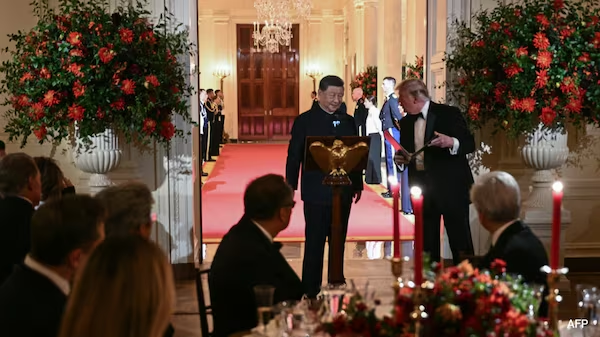
Washington: US President Donald Trump hosted Chinese President Xi Jinping at the White House in a high-profile meeting that brought several of the most sensitive issues in US-China relations back into focus. Trade, Taiwan, artificial intelligence and the broader strategic relationship between the two countries dominated discussions during Xi’s visit.
The meeting was accompanied by an elaborate state dinner and a series of ceremonial events in Washington. Several prominent business and technology figures, including Tesla’s Elon Musk, Apple CEO Tim Cook, Nvidia CEO Jensen Huang and OpenAI chief Sam Altman, were among those attending the dinner. Their presence highlighted the growing importance of technology and artificial intelligence in the relationship between the two countries.
During the dinner, Trump spoke positively about his relationship with Xi, saying that although the two leaders represent different political and economic systems, ties between their people remain important. He said the two countries could continue working toward greater prosperity and security.
Xi also struck a constructive tone in his remarks. He referred to Trump’s goal of making America great again and said China remained committed to its own national development ambitions. According to Xi, the two goals could potentially support each other rather than necessarily being in conflict.
Trade Remains a Major Point of Discussion
Trade continues to be one of the most important areas of disagreement between Washington and Beijing. According to the report, the two countries agreed to extend their existing trade truce by two months, giving officials additional time to work through unresolved economic issues.
US Treasury Secretary Scott Bessent said the extension would provide both sides with more time to determine what further progress could be made on economic matters.
However, several disagreements remain. These include tariffs, Chinese purchases of American goods, supplies of rare-earth materials and restrictions involving advanced technology.
US officials said China was meeting its commitment to purchase 25 million tons of soybeans but was behind on a separate commitment involving $17 billion worth of other agricultural products. Washington has also raised concerns about the pace of rare-earth deliveries from China.
The temporary extension therefore does not remove the underlying disagreements. Instead, it gives both sides additional time to continue negotiations and attempt to address the outstanding issues.
Taiwan Remains a Sensitive Issue
Taiwan was another major subject surrounding the summit. Xi urged Washington to handle what China calls the “Taiwan question” carefully, according to China’s official news agency.
The Chinese side also expressed hope that the United States would oppose Taiwanese independence.
The report noted that there was no indication that the Trump administration intended to change Washington’s longstanding position regarding Taiwan. The United States has traditionally avoided explicitly supporting Taiwan independence while maintaining its existing policy framework toward the island.
The absence of a detailed White House readout of the exchange left some aspects of the discussion unclear. Nevertheless, Taiwan remains one of the most sensitive issues in US-China relations and an important part of the broader strategic relationship between the two countries.
AI Becomes a Growing Area of Difference
Artificial intelligence was another key issue at the summit, with Trump and Xi presenting different views on how the rapidly developing technology should be managed.
Trump has argued against introducing additional broad restrictions on AI development and said the United States should allow the technology to continue advancing. He has also said that existing institutions, including the US Department of Justice, could play a role where necessary.
Xi presented a different emphasis. He said the United States and China, as two leading AI powers, have both the ability and responsibility to develop the technology while also managing its risks.
Xi stressed that AI development should remain under human control and should ultimately serve public well-being.
The contrasting positions reflect a broader debate over how governments should balance technological innovation with regulation, safety and oversight.
Concerns About Strategic Competition
Beyond trade and technology, the summit also highlighted concerns about the possibility of deeper strategic confrontation between the two countries.
Xi again referred to the concept known as the “Thucydides trap”, which describes the risks that can emerge when a rising power challenges an established power.
He argued that competition between China and the United States should focus on progress rather than confrontation. Xi also called for regular military communication and stronger mechanisms to prevent misunderstandings from escalating into a crisis.
The issue is significant because the United States and China are the world’s two major powers, with differences extending across trade, technology, security and regional affairs.
Trump, meanwhile, emphasized areas where the two countries have shared interests and referred to their historical cooperation during the Second World War as an example of how cooperation can be possible despite major differences.
A Summit Also Focused on Ceremony and Image
The meeting was not limited to policy discussions. The visit also featured elaborate ceremonies and carefully planned displays designed to highlight the importance of the occasion.
After Xi had hosted Trump in Beijing with visits to historic sites and locations not routinely opened to foreign visitors, Trump arranged his own ceremonial welcome in Washington.
The events included military personnel in historical-style uniforms, musical performances and ceremonies at the White House. Fighter jets and bombers also flew overhead as part of the proceedings.
The highly visual nature of the visit added another dimension to the summit, even as the most important policy discussions remained focused on difficult issues such as trade, Taiwan, AI and strategic competition.
What the Summit Shows
The Trump-Xi summit highlighted the complicated nature of the US-China relationship. Both leaders publicly emphasized the importance of cooperation and the possibility of maintaining stable relations, while major disagreements remain unresolved.
The extension of the trade agreement provides additional time for negotiations, but issues involving tariffs, agricultural purchases, rare-earth supplies and technology restrictions are still on the table.
Taiwan remains a particularly sensitive security issue, while artificial intelligence is emerging as another important area where Washington and Beijing have different approaches.
At the same time, both sides have acknowledged the need to avoid unnecessary confrontation and maintain communication.
The summit therefore did not eliminate the differences between the two countries. Instead, it brought those differences into clearer focus while providing another opportunity for the two governments to continue negotiations and manage their increasingly complex relationship.
News source: Information for this article was gathered from a variety of reliable news outlets.