India Responds to Shehbaz Sharif’s UN Remarks, Warns Terrorism Will Have Consequences
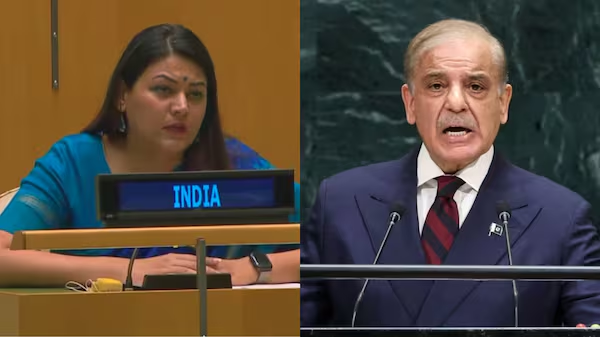
New Delhi: India strongly responded to Pakistan Prime Minister Shehbaz Sharif’s remarks at the United Nations General Assembly, rejecting his claims about the 2025 India-Pakistan conflict and his repeated references to Kashmir.
Sharif, while addressing the UN General Assembly in New York on Friday, credited US President Donald Trump for what he described as a “timely intervention” during the conflict between India and Pakistan in 2025. He also once again raised the Kashmir issue during his speech.
India exercised its right of reply on Saturday, with Indian diplomat Petal Gehlot delivering a sharp response to the Pakistani prime minister’s remarks. Gehlot questioned Pakistan’s position on terrorism and highlighted the presence of Osama bin Laden in Pakistan, noting that the mastermind of the 9/11 attacks had been found living near a major Pakistani military academy.
India also accused Pakistan of taking contradictory positions on terrorism, saying that Islamabad presents itself as a supporter of security while, according to India, supporting terrorism. The Indian representative warned that continued terrorism would have consequences and stressed that India would exercise its right to defend itself.
The exchange comes against the backdrop of Operation Sindoor, launched by India on May 7, 2025, following the April 22 Pahalgam terror attack in which 26 civilians were killed. India has maintained that the operation targeted terror infrastructure in Pakistan and Pakistan-occupied Kashmir.
The issue of US involvement in ending the 2025 conflict has also remained a point of disagreement. Donald Trump has repeatedly said that his intervention helped stop the fighting between India and Pakistan. New Delhi, however, has consistently rejected the suggestion that a third party played a role in bringing an end to the conflict.
During the diplomatic exchange, India also criticised Pakistan’s presentation of itself before the international community. Indian representatives argued that repeating the same claims at international forums does not make them factual and called on the UN to examine Pakistan’s policies and record rather than relying solely on its official statements.
Kashmir remained another major point of contention. Sharif referred to the Kashmir issue in his UN speech and argued that a lasting and fair solution was necessary to prevent another major conflict in South Asia.
India rejected Pakistan’s position and reiterated that Jammu and Kashmir is an integral and inalienable part of India. Gehlot also turned attention towards Pakistan-occupied Kashmir, raising allegations of killings and human-rights violations there and calling for greater international scrutiny of the situation.
The Indian diplomat further challenged Pakistan’s references to democracy, human rights and religious tolerance by pointing to what India described as Islamabad’s own record on these issues. She also criticised Pakistan’s treatment of minorities and referred to the country’s blasphemy laws.
Another important issue raised during the exchange was the Indus Waters Treaty (IWT). Pakistan referred to the treaty during Sharif’s address, while India has maintained that the agreement will remain in abeyance until Pakistan takes credible and irreversible steps to end support for cross-border and other forms of terrorism.
India announced the decision to put the treaty in abeyance after the Pahalgam attack, as part of a broader set of diplomatic and economic measures announced following the incident.
The latest UN exchange highlights the continuing diplomatic tensions between India and Pakistan. While both countries continue to present sharply different accounts of the 2025 conflict, Kashmir, terrorism and the Indus Waters Treaty remain among the central issues shaping their relations.
India’s latest message at the UN was also a warning that it would continue to assert its right to respond to terrorism. Gehlot said India had demonstrated during the previous year that terrorists would have “nowhere to run and nowhere to hide” and stressed that continued terrorism from Pakistan would have consequences.
News source: Information for this article was gathered from a variety of reliable news outlets.