Farmers’ March to Delhi Halted at Shambhu Border as Protest Against India-US Trade Deal Intensifies
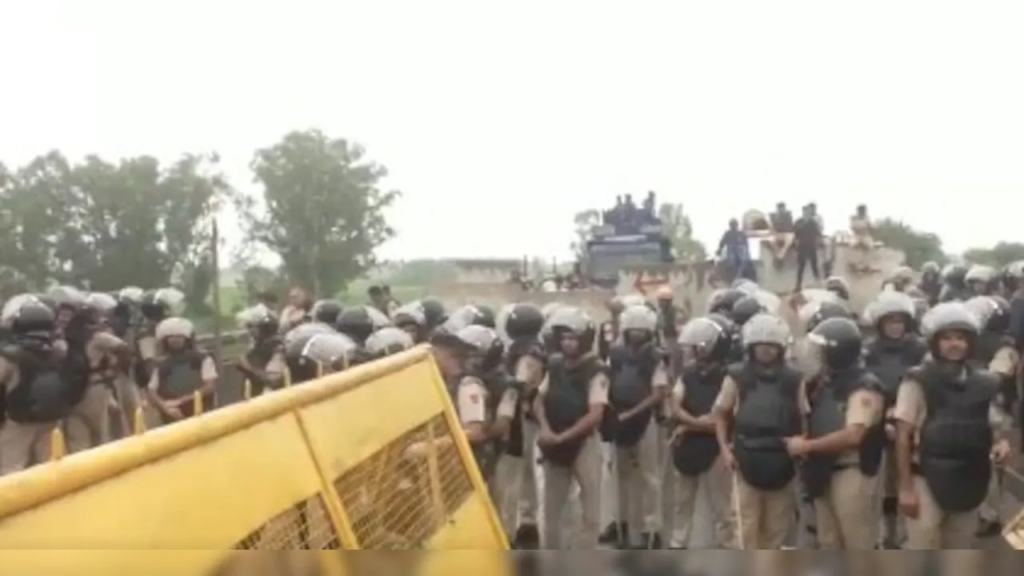
New Delhi, July 21: Hundreds of farmers from Punjab were stopped by Haryana Police at the Shambhu border on Tuesday as they attempted to march towards Delhi to participate in a Kisan Mahapanchayat protesting the proposed India-US trade agreement. The heavy security deployment at the Punjab-Haryana border brought back memories of the 2024 “Delhi Chalo-2” farmers’ agitation, when the same route was heavily fortified to prevent protesters from reaching the national capital.
Authorities installed multiple barricades at the Shambhu border, blocking the movement of farmers heading to Delhi. As a result, the border quickly turned into a protest site, with farmers accusing both the Haryana and Punjab governments of denying them their democratic right to peacefully assemble and raise their concerns.
Leaders of the Bharatiya Kisan Union (BKU) Shaheed Bhagat Singh alleged that Haryana Police had placed barricades inside Punjab’s territory. They also criticised the Punjab government for not intervening, claiming it remained a silent spectator while farmers were stopped from proceeding.
Despite the blockade for Punjab farmers, farmer groups from Haryana, including Ambala, Kurukshetra and nearby districts, continued their journey to Delhi without facing similar restrictions.
The protest has been organised under the banner of the Desh Bachao Morcha, bringing together farmer organisations from Punjab, Haryana and Himachal Pradesh. Their primary demand is that the Centre should not move forward with the proposed India-US trade agreement without first consulting those who would be directly affected, especially farmers and rural communities.
Kisan Mazdoor Sangharsh Committee (KMSC) leader Sarwan Singh Pandher said convoys belonging to several farmer organisations, including the KMSC, Kisan Mazdoor Morcha (Punjab chapter), Azaad Kisan Morcha and BKU Ekta Sangharsh, had started their journey from different parts of Punjab before being stopped at the Shambhu border.
Farmer leaders argue that the proposed India-US trade agreement could have long-term consequences for India’s agricultural sector. Referring to the joint statement issued by India and the United States in February 2026, they said both countries had agreed to negotiate the first phase of a multi-sector bilateral trade agreement by the fall of 2026.
According to the protesting organisations, the proposed agreement extends far beyond conventional trade and may include negotiations related to agriculture, dairy, industry, digital trade, e-commerce, investments, government procurement, intellectual property rights and the services sector.
The farmers fear that reducing tariffs and easing import restrictions on subsidised American agricultural products could severely impact Indian farmers. They believe products such as soybeans, maize, cotton, ethanol, apples, almonds, dairy products, poultry and fisheries from the US could flood the Indian market, making it difficult for small and marginal farmers to compete.
Farmer organisations also expressed serious concern over the lack of transparency in the ongoing negotiations. They alleged that the government has not made the details of the proposed agreement public, leaving millions of stakeholders uncertain about its potential impact.
Highlighting the importance of the dairy sector, farmer leaders said nearly 80 million rural families depend on dairy farming for their livelihood. They warned that opening the market to cheaper imported dairy products could trigger widespread economic hardship, affecting dairy producers, small traders, food processing units, agri-based industries and rural businesses across the country.
The Desh Bachao Morcha has demanded that the Central Government immediately release all documents related to the proposed India-US trade agreement and ensure that no final agreement is signed without extensive consultations with farmers, workers, dairy producers, small traders and other stakeholders.
With tensions rising once again at the Shambhu border, the farmers’ protest is expected to remain a key political and economic issue as discussions over the India-US trade agreement continue.
News source: Information for this article was gathered from a variety of reliable news outlets.