CBI Books Senior GST Officer Over Alleged ₹1 Crore Bribe to Derail ₹21 Crore GST Fraud Investigation
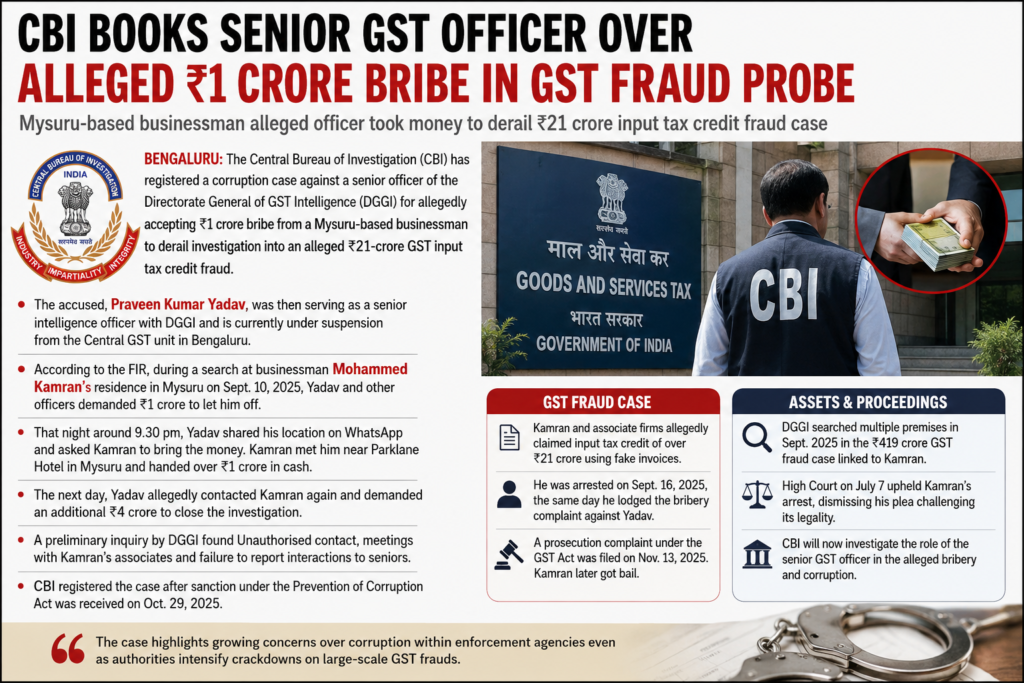
Bengaluru: The Central Bureau of Investigation (CBI) has registered a corruption case against a senior officer of the Directorate General of GST Intelligence (DGGI) for allegedly accepting a ₹1 crore bribe from a Mysuru-based businessman in exchange for weakening an investigation into an alleged ₹21 crore GST input tax credit fraud.
The accused, Praveen Kumar Yadav, who was serving as a Senior Intelligence Officer with the DGGI at the time of the incident, is currently under suspension from the Central GST unit in Bengaluru.
Alleged Bribe to Influence Investigation
According to the CBI’s FIR, the alleged incident took place on September 11, 2025, when businessman Mohammed Kamran, a scrap material trader from Mysuru, claimed he paid ₹1 crore in cash after being assured that the investigation against him would be softened.
The case was officially registered after the investigating agency received the required sanction under the Prevention of Corruption Act. The action also follows a recent Karnataka High Court order that upheld Kamran’s arrest by the DGGI in connection with the GST fraud case.
Search Operation and Bribery Allegations
Kamran alleged that during a search conducted at his residence in Bannimantap, Mysuru, on September 10, 2025, Praveen Kumar Yadav and other GST officials demanded ₹1 crore to help him avoid legal action.
According to the complaint, later that evening Yadav allegedly shared his location through WhatsApp and asked Kamran to deliver the money. The businessman claimed he met the officer near Parklane Hotel in Mysuru and handed over ₹1 crore in cash.
The complaint further alleged that the following day Yadav contacted him again through WhatsApp, this time demanding an additional ₹4 crore to completely close the investigation.
Internal Inquiry Found Suspicious Contact
A preliminary inquiry conducted by the DGGI reportedly found that Yadav had maintained unauthorised communication with Kamran and met people linked to him near the Parklane Hotel area.
Investigators also alleged that the officer failed to report these interactions to his senior officials, raising serious concerns about his conduct during the investigation.
Following the inquiry, the DGGI submitted a formal complaint to the CBI in October 2025, seeking an independent corruption investigation.
Background of the GST Fraud Case
The bribery allegations are linked to an investigation into an alleged ₹21 crore fraudulent input tax credit scam.
According to GST officials, Mohammed Kamran, proprietor of M.K. Traders, and associated firms allegedly claimed fake input tax credits using forged invoices issued by non-existent suppliers without any actual supply of goods or services.
The broader investigation reportedly involved transactions worth nearly ₹419 crore, making it one of the major GST fraud cases under scrutiny.
Kamran was arrested by the DGGI on September 16, 2025, after arriving at Kempegowda International Airport in Bengaluru. His father, Akram Pasha, identified as the prime accused in the GST fraud case, had reportedly been absconding following raids conducted at multiple locations.
Interestingly, Kamran lodged the corruption complaint against the GST officer on the very day he was arrested.
Court Proceedings Continue
A prosecution complaint under the GST Act was filed against Kamran in November 2025. Although he was later granted bail, his challenge before the Karnataka High Court claiming that his arrest was illegal was dismissed earlier this month.
Meanwhile, the CBI will now investigate whether the senior GST officer abused his official position by allegedly demanding and accepting bribes to influence the outcome of a tax fraud investigation.
The case has drawn attention to concerns over corruption within enforcement agencies, even as authorities continue efforts to crack down on large-scale GST fraud and financial crimes across the country.
News source: Information for this article was gathered from a variety of reliable news outlets.