Madhya Pradesh’s Wildlife Crisis Deepens: 50 People and 45 Tigers Dead in Just 8 Months
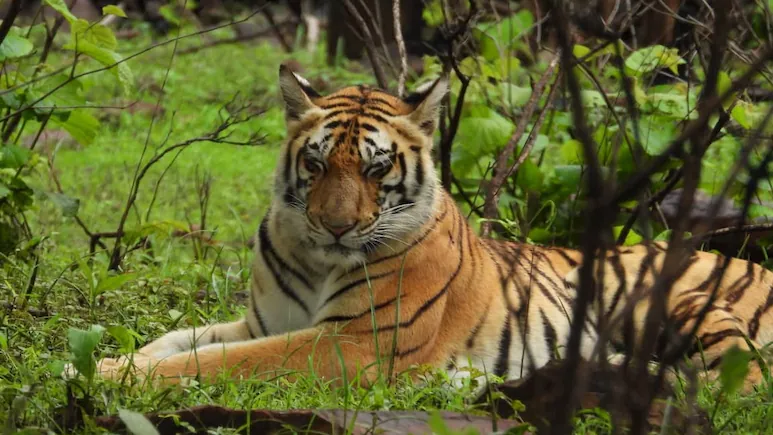
Madhya Pradesh : Madhya Pradesh is widely celebrated for its thriving wildlife, especially its growing tiger population. But behind that conservation success is a worrying reality: people and wild animals are increasingly coming into conflict.
In the first eight months of 2026, at least 50 people have lost their lives in wild animal attacks across Madhya Pradesh. During roughly the same period, more than 45 tigers have also died, highlighting the growing risks faced by both humans and wildlife.
Tigers Account for the Highest Number of Human Deaths
According to the latest Madhya Pradesh Forest Department figures, tigers have been responsible for the highest number of human fatalities this year.
Of the 50 people killed in wild animal attacks, 22 were victims of tiger attacks. Wild boars were responsible for eight deaths, elephants for seven, sloth bears for four and leopards for one. At least 16 of those who died were women and girls, while the remaining victims were men and boys.
The deaths have also been concentrated in a short period. Thirty people were killed in just three months — seven in March, 13 in April and 10 in May.
These months coincide with the period when many villagers, particularly members of tribal communities, enter forest areas to collect tendu leaves and mahua flowers. This seasonal dependence on forest resources brings people into closer contact with wildlife and increases the chances of dangerous encounters.
Seoni and Bandhavgarh Among the Worst-Hit Areas
Tiger attacks have been particularly deadly in the Mahakoshal region. Of the 22 people killed by tigers, 14 died in this densely forested area, especially in and around Seoni.
The region is famous for the forests associated with Rudyard Kipling’s The Jungle Book. Another seven tiger-related deaths were reported from Bandhavgarh Tiger Reserve and surrounding areas, which are home to some of Madhya Pradesh’s highest tiger densities.
The conflict, however, is not limited to tigers. Eight people have been killed by wild boars, while seven died in elephant attacks, mainly in eastern districts bordering Chhattisgarh such as Anuppur, Sidhi and Shahdol. Three of the four reported sloth bear deaths also occurred in eastern districts near the Chhattisgarh border.
A Problem That Has Been Growing for Years
The latest figures are part of a much larger pattern. Forest Department data shows that 406 people were killed in wild animal attacks in Madhya Pradesh between 2020-21 and 2024-25.
The state recorded 90 deaths in 2020-21, followed by 80 in 2021-22, 86 in 2022-23, 79 in 2023-24 and 71 in 2024-25. During the same five-year period, more than 5,800 people were injured and over 72,000 livestock were lost in wildlife-related incidents.
The financial burden has also been significant. Madhya Pradesh paid more than Rs 88.38 crore in compensation for human deaths and livestock losses between 2020-21 and 2024-25. In 2024-25 alone, compensation payments crossed Rs 20.05 crore.
But compensation alone cannot address the reasons behind the continuing deaths.
When Forests and Villages Begin to Overlap
Forest officials describe an expanding number of “conflict zones” where villages, farms and daily livelihood activities overlap with wildlife movement.
Madhya Pradesh has the country’s highest tiger population and also has the highest number of leopards, along with large sloth bear habitats and an increasing elephant presence in its eastern districts. At the same time, roads, railway lines, farms and settlements are increasingly cutting through forest areas and wildlife corridors.
Many encounters do not happen deep inside forests. Instead, they take place along forest fringes, where villagers collect firewood, graze cattle, gather tendu leaves and mahua flowers or cultivate fields close to forest boundaries.
Wild animals face their own challenges. Tigers and other species sometimes leave protected areas in search of territory, prey and water, bringing them into landscapes dominated by people.
Tiger Conservation Success Has Created a New Challenge
Madhya Pradesh’s tiger population has grown significantly. The 2022 national tiger estimation put the state’s tiger population at 785, while officials and experts now estimate it to be around 1,000.
But the space available for these animals has not increased at the same pace.
An adult male tiger may need a territory of around 50 to 100 square kilometres, depending on habitat, prey and competition. Madhya Pradesh has nine tiger reserves covering around 16,233 square kilometres, including core and buffer areas.
Yet tigers do not stay within reserve boundaries. Young tigers forced out by dominant animals often travel long distances in search of territory. Their journeys can take them through forests, farms, village edges and fragmented wildlife corridors.
Anger Exploded After Tiger Attacks Near Pench
The tension became particularly visible in April, when two people were killed in tiger attacks within 13 days in and around Pench Tiger Reserve.
One victim was 30-year-old Dinesh Sevatkar, who entered a forest area near a water body around dusk, a location frequently used by tigers. He was mauled to death.
His death triggered intense anger among local villagers. Hundreds reportedly entered parts of the reserve, damaged gates and vehicles and allegedly set sections of the forest on fire.
Earlier that month, another villager collecting mahua flowers before dawn was killed in the Kumbhapani buffer area. Similar conflicts have also been reported around Bandhavgarh and Satpura.
For communities living along forest boundaries, the issue is deeply personal. Conservation may protect India’s national animal, but for families whose livelihoods depend on entering the forest, a tiger can also represent a serious and immediate threat.
Tigers Are Dying Too
The crisis has another side: Madhya Pradesh is also losing a significant number of tigers.
More than 45 tiger deaths have been reported in the state during the first eight months of 2026. Tigers can die from natural causes, territorial fights, disease and old age. But deaths can also result from road and railway accidents, electrocution, poisoning and poaching.
The high number of deaths raises concerns about whether the state’s expanding tiger population is increasingly coming into contact with a fragmented and hazardous landscape.
Questions have also been raised over unresolved tiger-death investigations. Earlier RTI-based findings reported that 88 tiger death cases from 2020 and 2021 across India remained unresolved or under scrutiny. Madhya Pradesh was among the states with cases still being examined, including incidents linked to important tiger landscapes such as Bandhavgarh, Kanha and Panna.
A Difficult Balance Between People and Wildlife
Madhya Pradesh now faces a complicated conservation challenge.
The state’s tiger population is growing, but safe spaces for animals to move and establish territories remain under pressure. At the same time, thousands of villagers continue to depend on forests for essential resources.
Roads, railway tracks, farms and settlements are increasingly crossing wildlife movement routes. Tigers move beyond protected areas in search of territory and prey, while people enter forests for mahua, tendu leaves, firewood and grazing.
The result is a difficult cycle in which both humans and wildlife are paying the price.
For Madhya Pradesh, the challenge is no longer simply about protecting tigers. It is about finding a way for people and wildlife to share an increasingly crowded landscape without either side losing more lives.
News source: Information for this article was gathered from a variety of reliable news outlets.