Xi Jinping Arrives in US as Trump Gives Chinese President Rare Airport Welcome, High-Profile State Visit Begins
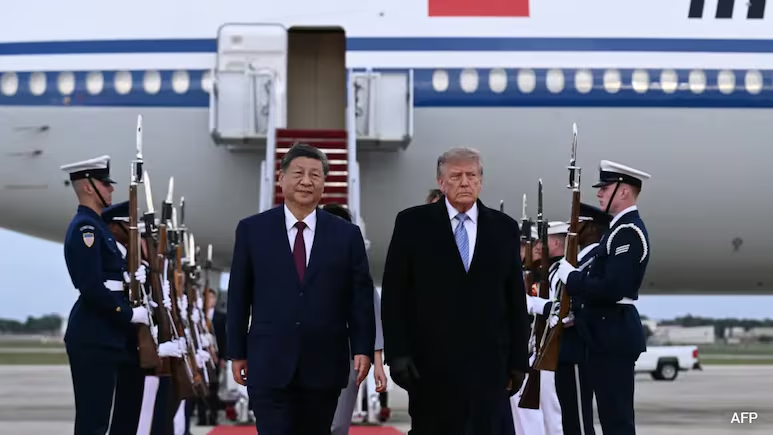
Washington: Chinese President Xi Jinping arrived in the United States on Wednesday for a closely watched state visit, receiving an unusually personal welcome from US President Donald Trump at Joint Base Andrews, the military airfield outside Washington.
The arrival marked the beginning of several days of high-profile diplomacy between the leaders of the world’s two largest economies. Their meetings are expected to cover a wide range of difficult issues, including trade, tariffs, artificial intelligence, technology and the broader strategic relationship between Washington and Beijing.
Trump and First Lady Melania Trump greeted Xi and his wife, Peng Liyuan, after they stepped off the Chinese president’s aircraft.
Trump, dressed in a long coat and gloves, stood alongside Xi on the tarmac as a military band performed. The ceremony was followed by a flyover involving two B-1 bombers, while six F-22 fighter jets and six F-16s were positioned on the airfield as part of the formal welcome.
The elaborate reception reflected the diplomatic importance Washington has attached to Xi’s visit.
A rare personal welcome from Trump
American presidents do not routinely travel to airports to personally receive visiting foreign leaders, making Trump’s appearance at Andrews notable.
Trump had previously given a similar welcome to Russian President Vladimir Putin during his visit to Alaska last year. Earlier examples of such airport receptions at Andrews include US President John F. Kennedy welcoming British Prime Minister Harold Macmillan in 1962 and President Dwight D. Eisenhower receiving Soviet leader Nikita Khrushchev in 1959.
The contrast was also noted because Trump reportedly did not receive the same airport welcome when he visited Beijing in May.
Xi’s visit will continue with a series of formal events, including another military flyover and a state dinner at the White House on Thursday.
The Chinese president is scheduled to leave Washington on Friday morning after a final meeting with Trump and the two presidential couples at the White House. The programme is also expected to include a visit to the National Archives, where the US Declaration of Independence is preserved.
Trade remains a major issue
Despite the pageantry surrounding the visit, trade is expected to remain one of the most important subjects during the leaders’ discussions.
Washington and Beijing have spent years dealing with tariff disputes and restrictions affecting trade and technology. Both sides have recently worked to maintain a temporary truce, but several major disagreements remain unresolved.
US Treasury Secretary Scott Bessent and Chinese Vice Premier He Lifeng held discussions ahead of Xi’s arrival. Their talks have included preparations for the presidential meeting and issues connected to trade and economic relations.
The two governments are also considering whether to extend the existing tariff arrangement in order to prevent another escalation.
Analysts cited in the report have suggested that expectations for a major breakthrough are limited. Instead, maintaining communication and extending the existing understanding could be a central objective of the discussions.
Artificial intelligence adds another difficult issue
Artificial intelligence is another major topic expected to feature in the talks.
The United States and China are competing for leadership in advanced AI technology, while governments and technology companies are also increasingly discussing the potential risks associated with rapidly developing AI systems.
Preliminary discussions between US and Chinese officials reportedly included the possibility of establishing a communication channel to discuss AI-related concerns.
However, there are limited expectations that the two countries will reach a comprehensive agreement on regulating AI during Xi’s visit.
The issue is complicated by the broader technological competition between Washington and Beijing, particularly over advanced computing, semiconductors and other strategic technologies.
China delegation arrives without major CEOs
Xi arrived in Washington accompanied by senior Chinese officials, including Cai Qi and Chinese Foreign Minister Wang Yi, according to Chinese state media.
However, reports said that Chinese business executives were not included in Xi’s delegation, despite the planned attendance of senior American technology executives at Thursday’s White House state dinner.
The difference highlights the increasingly strategic nature of the US-China technology relationship, particularly at a time when both countries are seeking greater influence over the future of artificial intelligence and advanced technology.
Questions over China’s relationship with Iran
The visit is also taking place against the backdrop of tensions involving Iran.
Some US lawmakers have criticised Trump’s decision to provide Xi with an elaborate welcome amid allegations that China supplied Iran with intelligence that could have been used in attacks against American troops.
Republican Senator Roger Wicker, chairman of the Senate Armed Services Committee, criticised the approach and argued that Washington should remain mindful of its strategic differences with Beijing.
Trump, however, has played down the importance of raising the allegations directly with Xi, pointing to the fact that both the United States and China conduct intelligence activities against each other.
The issue could nevertheless remain part of the wider geopolitical environment surrounding the summit.
Focus on maintaining stability
For both governments, keeping the relationship stable remains a significant challenge.
The United States and China are economic partners in some areas but strategic competitors in others. Their disagreements extend from trade and technology to Taiwan and broader questions about global influence.
Because of these differences, the meetings between Trump and Xi are being watched closely for any indication of whether the two governments can maintain their current diplomatic and trade arrangements.
Rather than expecting an immediate resolution of every dispute, officials and analysts cited in the report have focused on the possibility of keeping communication open and preventing tensions from escalating.
A visit shaped by symbolism and diplomacy
Xi’s arrival has therefore combined traditional state ceremony with difficult geopolitical issues.
The military aircraft, honour guard and personal airport greeting provided a highly visible demonstration of the importance attached to the Chinese president’s visit. Behind the ceremony, however, the two governments continue to face complicated negotiations over tariffs, technology, AI and strategic competition.
Xi has also emphasised the importance of managing the relationship between the two countries despite their differences.
The coming meetings at the White House are expected to provide an opportunity for Trump and Xi to discuss those issues directly and determine how Washington and Beijing will manage their relationship in the months ahead.
For now, the visit represents another attempt by the two governments to keep dialogue going at a time when economic and geopolitical tensions remain significant.
News source: Information for this article was gathered from a variety of reliable news outlets.