Trump-Xi Summit: Plenty of Ceremony, But Limited Substance — What It Could Mean for India
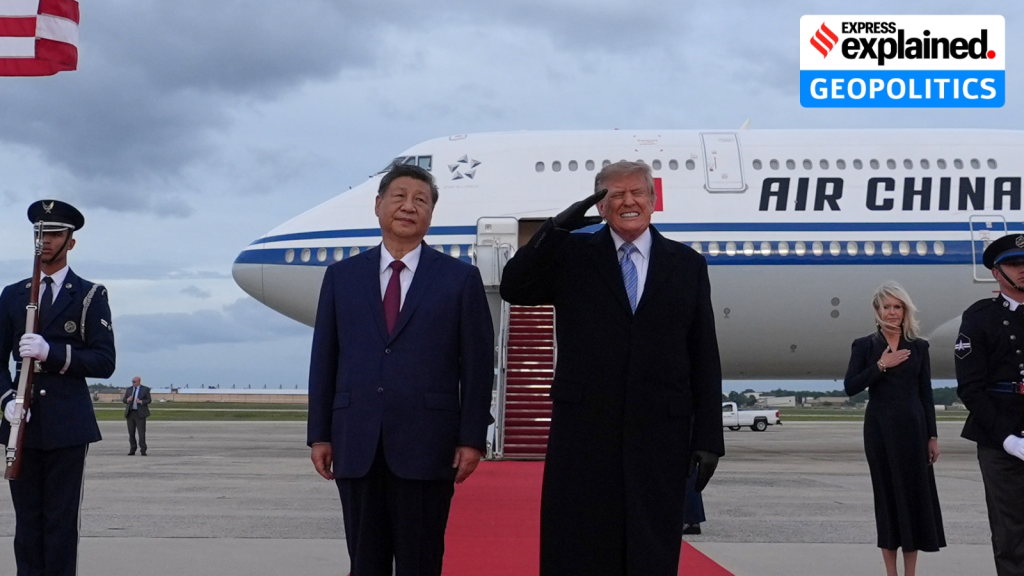
New Delhi: The much-anticipated meeting between US President Donald Trump and Chinese President Xi Jinping attracted considerable global attention, not just because of the importance of the two leaders, but also because of the elaborate symbolism surrounding their encounter. Yet, despite the high-profile reception and diplomatic showmanship, the summit appears to have produced relatively limited concrete outcomes, leaving several important questions unresolved — including issues that could have consequences for India.
One of the most striking elements of Xi’s visit was the decision by President Trump to personally welcome the Chinese leader at the airport. It was a gesture rarely seen in recent decades. The last time a sitting US president had gone to an airport to receive a visiting foreign leader was in 1962, when President John F Kennedy welcomed British Prime Minister Harold Macmillan.
Trump’s decision to revive that tradition for Xi underlined the importance Washington attaches to its relationship with Beijing. The reception, military ceremony and highly visible diplomatic gestures created an image of warmth and renewed engagement between the world’s two largest economies.
However, behind the carefully managed optics, several of the most important issues remained unresolved.
No breakthrough on artificial intelligence
Artificial intelligence was among the major areas where expectations were high ahead of the meeting. Both the United States and China are competing aggressively in advanced AI, semiconductors and other emerging technologies, making the subject particularly sensitive from both economic and national-security perspectives.
Yet the summit did not result in a major agreement on AI.
The absence of a concrete understanding suggests that Washington and Beijing continue to have significant differences over technology, access to advanced computing capabilities, semiconductor restrictions and the broader strategic implications of artificial intelligence.
For the United States, limiting China’s access to certain advanced technologies has become an important part of its broader strategy toward Beijing. China, meanwhile, has been working to strengthen its domestic technological capabilities and reduce dependence on American technology.
The summit therefore offered dialogue, but apparently did not resolve the deeper technological competition between the two countries.
Trade truce extended, but tensions remain
Trade was another central issue on the agenda.
Rather than announcing a sweeping new trade agreement, the two sides agreed to extend their existing truce for another two months. While such an extension can provide businesses with some temporary certainty, it also means that the larger disagreements between Washington and Beijing have not disappeared.
The US-China trade relationship has been marked by tariffs, restrictions and negotiations for years. Any fresh escalation could affect global supply chains, commodity markets and countries that trade extensively with both economies.
For India, the situation becomes particularly important because of the possibility of tariffs linked to Russian oil.
Why India is watching closely
One of the concerns highlighted by the summit is the uncertainty surrounding US pressure over countries continuing to purchase Russian oil.
India has remained a major buyer of Russian crude, particularly since the disruption of global energy markets following Russia’s invasion of Ukraine. Russian oil has played an important role in India’s energy-import strategy, while New Delhi has consistently maintained that its priority is ensuring affordable and reliable energy supplies for its population.
The possibility of additional US tariffs or other economic measures connected to Russian oil purchases therefore remains a concern for India.
If Washington and Beijing continue to negotiate their own trade arrangements while the issue of Russian oil remains unresolved, India could find itself dealing with a complicated external environment. The outcome of US-China negotiations can have wider consequences for countries that are not directly involved in the talks.
A summit dominated by symbolism
The elaborate welcome for Xi was undoubtedly significant from a diplomatic and political perspective. Trump’s decision to personally receive him, along with the ceremonial elements of the visit, demonstrated the importance both governments place on maintaining communication.
But symbolism and substance are not necessarily the same thing.
The absence of a major AI agreement and the relatively short extension of the trade truce indicate that many of the fundamental disagreements between Washington and Beijing remain in place.
The two countries continue to compete over technology, trade, manufacturing, strategic influence and access to critical resources. A temporary easing of tensions does not necessarily mean that the underlying rivalry has ended.
What the summit means for the wider world
The US-China relationship has consequences far beyond the two countries. Their decisions influence global trade, investment, technology supply chains, manufacturing and energy markets.
For countries such as India, the challenge is to navigate these shifting relationships without becoming excessively dependent on any one major power.
The summit may therefore be less about a dramatic new agreement and more about what it reveals regarding the current state of US-China relations. Washington and Beijing appear willing to keep talking and prevent tensions from escalating uncontrollably, but major disagreements continue to shape the relationship.
For India, the immediate concern is that unresolved issues elsewhere — particularly those involving trade and Russian energy — could create fresh economic and diplomatic complications.
The Trump-Xi meeting may have delivered a powerful diplomatic spectacle, but the limited number of substantive breakthroughs means that many of the difficult questions remain on the table. For New Delhi, the next few months could be more important than the ceremony itself, particularly as the US-China trade truce approaches its next deadline and Washington’s approach toward Russian oil continues to evolve.
News source: Information for this article was gathered from a variety of reliable news outlets.