RSS Leader Urges Youth to Study CJP Movement, Cautions Against ‘Grammar of Anarchy’
Chhatrapati Sambhajinagar, August 3:
Rashtriya Swayamsevak Sangh (RSS) Joint General Secretary Atul Limaye has urged young people to closely examine the recent Cockroach Janta Party (CJP) movement, saying that understanding the background, organisation, and ideology behind such protests is essential rather than judging them only by their immediate impact.
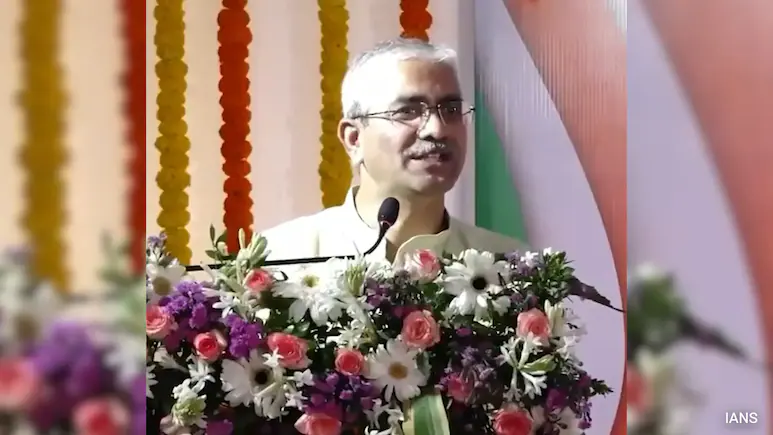
Speaking at an event organised by the Akhil Bharatiya Vidyarthi Parishad (ABVP) in Maharashtra’s Chhatrapati Sambhajinagar, Limaye said the movement that led to the resignation of former Union Education Minister Dharmendra Pradhan should be studied as a case study to understand how public movements evolve and gain momentum.
He explained that every movement has multiple layers, including its planning, support systems, networks, and ideological influences. According to him, these aspects deserve careful analysis instead of focusing only on the visible protests.
Tracing the timeline of the movement, Limaye said CJP founder Abhijeet Dipke first launched the campaign online, where it initially received encouraging support. After arriving in India on June 6, Dipke formally launched the movement on June 7 and travelled to several cities until June 19, but the campaign did not attract significant public participation during that period.
He claimed the movement changed dramatically after protesters began a sit-in at Jantar Mantar in Delhi on June 20. Limaye said this shift raised important questions about how different organisations came together and what factors helped expand the movement across the country.
According to Limaye, several student organisations, including All India Students’ Association (AISA) and the Students’ Federation of India (SFI), along with groups working on human rights, tribal issues, women’s rights, minority rights, farmers, labour, environmental causes, journalism and legal aid, either directly or indirectly became associated with the protests. He argued that understanding these networks is necessary to fully understand the movement’s objectives.
The RSS leader also questioned how a movement that initially focused on students eventually expanded into a wider political campaign. He said issues such as the slogans raised, speeches delivered, participation of different organisations, and the movement’s international support should all be examined objectively. However, the report noted that Limaye did not provide evidence to support his allegations regarding anti-Hindu or anti-national slogans.
During his address, Limaye referred to Italian thinker Antonio Gramsci’s theory of cultural hegemony, claiming that certain ideological groups attempt to influence society by challenging established institutions, traditions, and cultural values. He argued that such strategies often involve shaping public opinion through education, media, literature, cinema, and universities before building large-scale public movements.
Recalling Dr. B.R. Ambedkar’s final speech in the Constituent Assembly on November 25, 1949, Limaye said Ambedkar had warned against unconstitutional methods of protest, describing them as the “Grammar of Anarchy.” He urged young people to remain committed to constitutional values while contributing positively to nation-building through patriotism, social responsibility, and constructive dialogue.
Responding to Limaye’s remarks, CPI(M) MP V. Sivadasan criticised the RSS, accusing it of not participating in India’s freedom struggle and attempting to divide people during the independence movement. Defending the student protests, he said the demonstrations were driven by concerns over examination paper leaks and inadequate investment in the education sector, adding that many students had been deeply affected by the issue.
News source: Information for this article was gathered from a variety of reliable news outlets.