Ram Temple Donation Case: SIT Detects 105 Alleged Theft Instances, Charge Sheet Expected by September 25
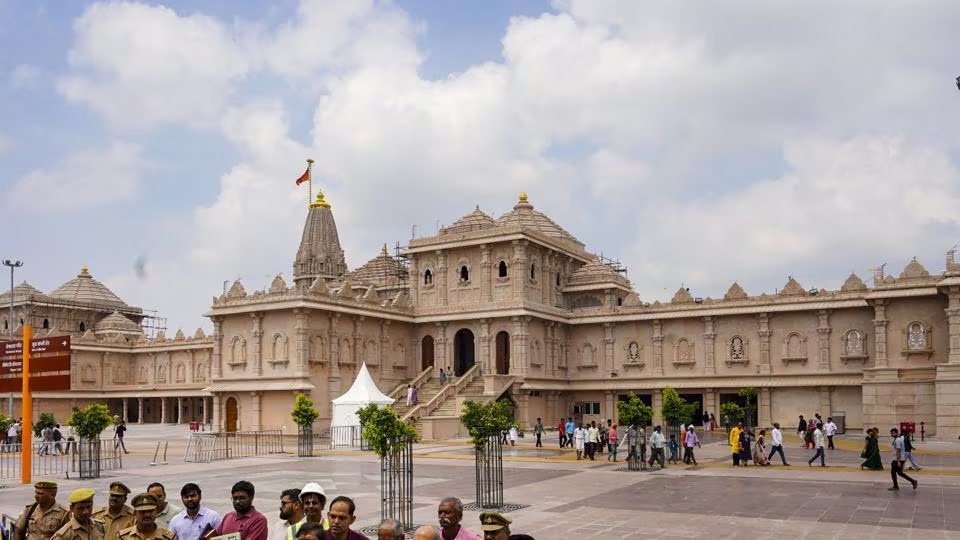
Lucknow: The investigation into alleged irregularities in the handling of donations at the Ram Temple in Ayodhya has moved into a crucial stage, with the Special Investigation Team (SIT) identifying 105 alleged instances of theft, according to people familiar with the matter.
Investigators have examined CCTV recordings, statements from witnesses and employees, donation-related documents and financial records to understand how offerings received at the temple were allegedly diverted before being deposited into the designated bank accounts.
The latest figure is higher than the 70 alleged instances mentioned in the interim report submitted by the first SIT headed by Vijay Vishwas Pant. The matter is now being investigated by a second SIT constituted following directions from the Supreme Court.
The investigating team is expected to file its charge sheet by September 25, a deadline that has significance under the law because the statutory 90-day period from the first arrest in the case is due to expire on that date.
Supreme Court takes note of SIT report
The latest developments were placed before the Supreme Court through a status report submitted on September 16.
A bench headed by Chief Justice of India Surya Kant, along with Justices Joymalya Bagchi and V Mohana, took note of the report during Monday’s hearing.
The court expressed satisfaction with the progress of the investigation but declined to make the status report available to the petitioners at this stage.
The judges indicated that they did not want to interfere with the jurisdiction of the sessions court while the investigation and related proceedings were continuing. The Supreme Court also kept open the possibility of issuing further directions if it later found that additional investigation was necessary.
Second SIT formed after Supreme Court intervention
The second SIT was constituted on July 26 after the Supreme Court directed a fresh investigation into the allegations.
The team includes Lucknow zone Inspector General of Police Kiran S, Ayodhya range Deputy Inspector General Somen Barma, Ayodhya Senior Superintendent of Police Gaurav Grover and Barabanki Additional SP Ritesh Kumar Singh.
Investigators have reportedly gone through hundreds of hours of CCTV footage. They have also examined digital logging records, receipts and bank deposit documents.
The objective has been to reconstruct the movement of donations from the point at which they were collected and counted to the stage when they were deposited into the temple’s designated banking arrangements.
According to people familiar with the investigation, the exercise was aimed at identifying discrepancies between the donations recorded and the amounts eventually deposited.
How investigators reconstructed the alleged diversion
The investigation has involved examining several different sources of evidence rather than relying on a single record.
CCTV footage was studied to establish the movement of personnel and donation collections. Investigators also examined digital entries and receipts relating to the handling of offerings.
Bank records were then compared with these details to determine whether the amounts deposited matched the donations recorded during the earlier stages of the process.
The SIT’s report also contains details about the procedure followed for handling valuables donated by devotees, the arrests already made and the evidence collected against the accused, according to people familiar with the matter.
The investigation is therefore looking not only at individual alleged theft incidents but also at the broader process through which cash and valuables were collected, counted, recorded and eventually deposited.
Eight people arrested in the case
The controversy first came to public attention on June 7, when Samajwadi Party leader Tej Narayan ‘Pawan’ Pandey alleged that between ₹5 crore and ₹7.5 crore worth of temple donations had been siphoned off.
Following the initial investigation, eight employees associated with the handling and counting of donations were arrested on June 26.
The accused have been booked under provisions of the Bharatiya Nyaya Sanhita relating to offences including criminal breach of trust, cheating, theft and criminal conspiracy. A provision of the Prevention of Corruption Act has also been invoked.
The accused are Anukalp Mishra, Lavkush Mishra, Ram Shankar Yadav alias Tinnu, Manish Yadav, Subhash Srivastava, Avinash Shukla, Rama Shankar Mishra and Karunesh Pandey.
The allegations against the accused remain subject to the ongoing criminal proceedings and determination by the courts.
Investigators recover nearly ₹80 lakh
During the investigation, officials also reportedly recovered ₹79,85,493 from the eight arrested individuals.
According to the report, investigators recovered money from unusual locations, including bathrooms, haystacks and cow-dung cakes.
The recovery has formed part of the evidence being examined by investigators as they attempt to establish the alleged flow of money and determine how the donations were handled before reaching the temple’s designated accounts.
The exact role of each accused and the evidentiary significance of the recovered amount will ultimately be considered through the legal proceedings.
Charge sheet deadline carries legal significance
The September 25 deadline is particularly important because it marks the completion of the statutory 90-day period from the first arrest in the case.
Under criminal procedure, if the investigating agency fails to file a charge sheet within the applicable statutory period in a case where the relevant period is 90 days, an accused who satisfies the legal requirements may become entitled to seek default bail.
The Uttar Pradesh government, represented before the Supreme Court by Solicitor General Tushar Mehta, assured the bench that the charge sheet would be filed by September 25.
The filing of the charge sheet would formally place the investigating agency’s case and the evidence it has gathered before the trial court.
Supreme Court keeps further investigation option open
While the Supreme Court took note of the SIT’s progress, it did not release the status report to the petitioners at this stage.
The court’s approach indicates that the proceedings are continuing within the framework of the sessions court, with the top court retaining the option of issuing further directions if necessary.
For investigators, the immediate priority is now to complete the remaining formalities and submit the charge sheet within the stipulated period.
Why the case has attracted attention
The Ram Temple donation case has drawn considerable public attention because it concerns offerings made by devotees at one of India’s most prominent religious sites.
Temple donations can include cash, jewellery and other valuables, making proper accounting and secure handling an important part of the administrative process.
The allegations have consequently raised questions about how donations were recorded, counted, transported and deposited.
The investigation is seeking to establish whether there were systematic discrepancies in this process and, if so, who was responsible for them.
Investigation moves towards the next stage
The identification of 105 alleged theft instances marks a significant development compared with the earlier figure cited in the first SIT’s interim report.
However, the identification of alleged instances during an investigation does not by itself establish guilt. The prosecution will have to present admissible evidence before the court, and the accused will have an opportunity to contest the allegations.
With the charge sheet expected by September 25, the case is now moving from the investigation stage towards the next phase of judicial proceedings.
The coming proceedings will provide greater clarity on the evidence collected by the SIT, the alleged role of individual accused persons and the financial trail identified by investigators.
For devotees and the wider public, the central issue remains the same: establishing what happened to the donations that were allegedly diverted and ensuring that the investigation and subsequent court proceedings determine responsibility on the basis of evidence.
News source: Information for this article was gathered from a variety of reliable news outlets.