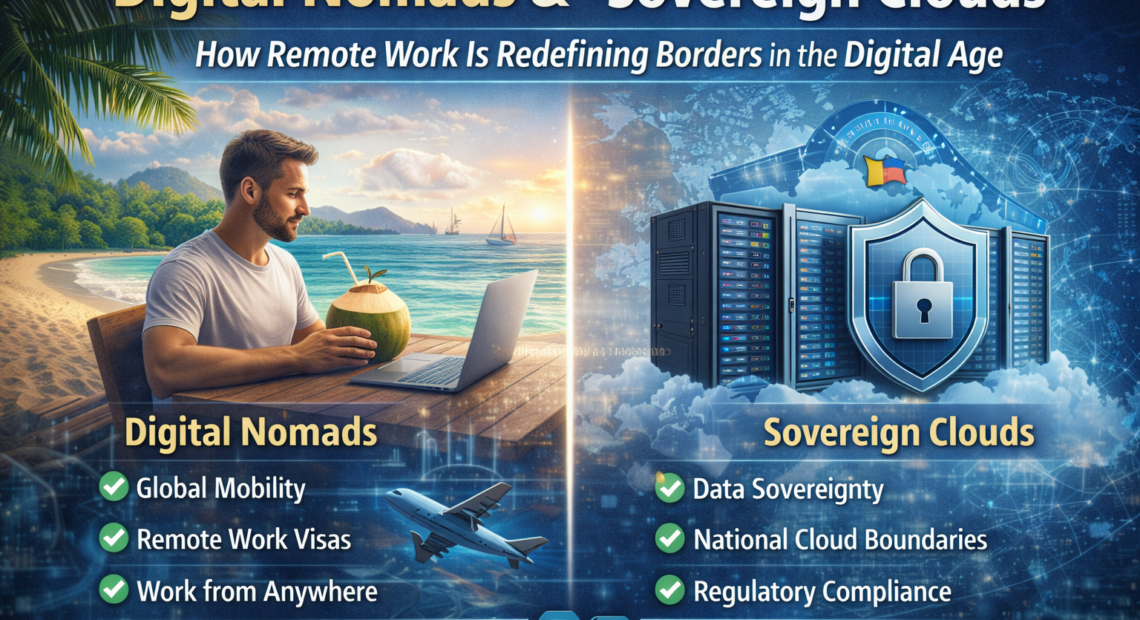
Digital Nomads & “Sovereign Clouds”: How Remote Work Is Redefining Borders in the Digital Age
Not long ago, the idea of working from a beach in Bali, a café in Lisbon, or a mountain town in Himachal Pradesh sounded like a dream. Today, for millions of professionals around the world, it has become a reality.
The rise of the digital nomad lifestyle has transformed the traditional concept of work. With only a laptop and a stable internet connection, professionals are now able to work from almost anywhere on the planet.
But as this global movement grows, another concept is quietly gaining attention in the world of technology and governance: Sovereign Clouds.
At its core, Sovereign Cloud refers to cloud computing systems designed to keep data within the legal and regulatory boundaries of a specific country. Governments are increasingly adopting these systems to ensure that sensitive data remains protected under national laws.
This shift reflects a broader challenge of the digital age: how to balance global connectivity with national control over data.
The Rise of the Digital Nomad
The remote work revolution accelerated dramatically during the COVID-19 pandemic. Companies realised that employees could remain productive even when working outside traditional offices.
As a result, thousands of workers began exploring the freedom of location-independent work. Designers, programmers, marketers, consultants, and entrepreneurs started travelling the world while continuing their careers online.
Countries like Portugal, Estonia, and Thailand have even introduced special digital nomad visas to attract remote workers and boost local economies.
For many professionals, this lifestyle offers something priceless — freedom and flexibility. It allows them to experience new cultures, manage their time independently, and escape the traditional nine-to-five routine.
Where Sovereign Clouds Come In
However, the global mobility of workers has created new concerns for governments and businesses. When employees access sensitive corporate or government data from different countries, questions arise about data security, privacy laws, and jurisdiction.
This is where Sovereign Cloud infrastructure becomes crucial.
Major technology companies such as Microsoft, Amazon Web Services, and Google are developing cloud solutions that allow organisations to store and process data within specific national boundaries while still benefiting from global cloud technology.
For businesses employing remote teams across multiple countries, these systems help ensure that regulatory compliance and data protection standards are maintained.
Freedom vs. Regulation
The coexistence of digital nomads and sovereign cloud systems represents a fascinating paradox of modern work.
On the one hand, technology allows workers to operate from anywhere in the world. On the other hand, governments are strengthening digital borders to protect data and national interests.
Experts believe the future workplace will need to navigate both realities — supporting global mobility while maintaining robust cybersecurity frameworks.
A New Era of Work
The intersection of remote work and sovereign cloud technology signals something bigger than just a workplace trend. It reflects how technology is reshaping the very idea of borders, workspaces, and digital identity.
For digital nomads, the world is becoming a workspace. For governments and companies, data sovereignty remains a top priority.
Somewhere between these two forces lies the future of work, one where freedom, technology, and responsibility must evolve together.
News Source : Information for this article was gathered from a variety of reliable news outlets.