US Spy Drone Over Cuba Sparks Fresh Geopolitical Signals Amid Global Oil Tensions
High above the Caribbean, far beyond the reach of commercial aircraft, a silent observer traced slow circles in the sky. It wasn’t armed, yet its presence alone sent a powerful message.
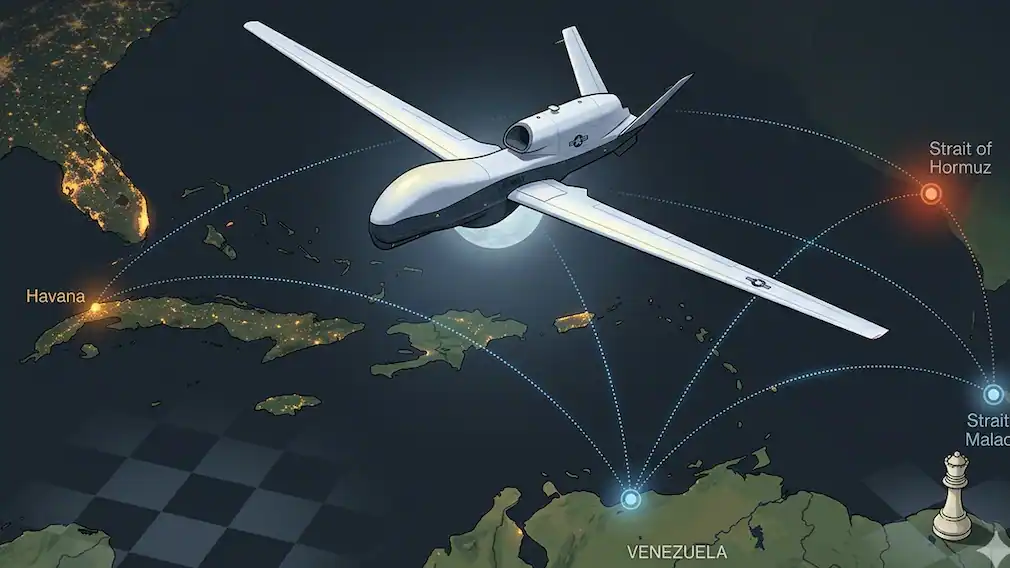
The aircraft was the MQ-4C Triton, one of the most advanced surveillance drones operated by the United States Navy — a machine designed not to strike, but to watch, track, and understand.
A Watchful Eye Over Cuba
Recent flight-tracking data shows that a US Navy MQ-4C Triton drone conducted a long-duration reconnaissance mission near Cuba, flying for over 12 hours at altitudes nearing 50,000 feet.
The drone, reportedly using the callsign “BLKCAT6,” made repeated passes near key locations including Havana and surrounding maritime routes. Its mission: monitor critical sea lanes in the Caribbean — a region often overlooked, but strategically vital.
Why These Waters Matter
The Caribbean isn’t just about geography — it’s about global trade.
Key shipping routes in this region connect the Atlantic Ocean to the Panama Canal and beyond. Any increased surveillance here hints at broader concerns about maritime security, trade flows, and geopolitical positioning.
Military analysts often interpret such visible deployments as strategic signalling — a way of saying, “we are watching.”
The Bigger Picture
The MQ-4C Triton isn’t new to tense regions. It has been actively used in surveillance missions over sensitive zones like the Strait of Hormuz, where global energy routes are constantly under watch.
Designed for long endurance — capable of staying airborne for over 24 hours — the drone can monitor vast ocean areas, track ship movements, and relay real-time intelligence.
Power Without Weapons
What makes the Triton remarkable is not firepower, but awareness.
Equipped with advanced radar and sensor systems, it can scan enormous areas of sea and airspace, identifying patterns and potential threats without ever firing a shot.
In modern warfare and diplomacy, information is often more powerful than missiles.
A Message Beyond the Mission
While the official purpose of such flights is surveillance, their visibility — especially through publicly accessible flight data — often carries deeper meaning.
Allowing such movements to be seen can act as a strategic signal to global powers, reinforcing presence without direct confrontation.
The New Battlefield: Sea Lanes and Data
As global tensions shift from traditional battlefields to supply chains and trade routes, monitoring key maritime corridors has become critical.
From the Persian Gulf to the Caribbean, surveillance missions like these highlight a changing reality:
control over information and movement is now as important as control over territory.
Conclusion
The flight of a single drone may seem routine, but in today’s geopolitical climate, it rarely is.
Hovering silently above the Caribbean, the MQ-4C Triton represents more than technology — it reflects a world where strategy, surveillance, and subtle signalling are shaping the balance of power.
News Source : Information for this article was gathered from a variety of reliable news outlets.