Delhi Tightens Security, Bans Gatherings Ahead of CJP’s ‘Chalo Sansad’ March
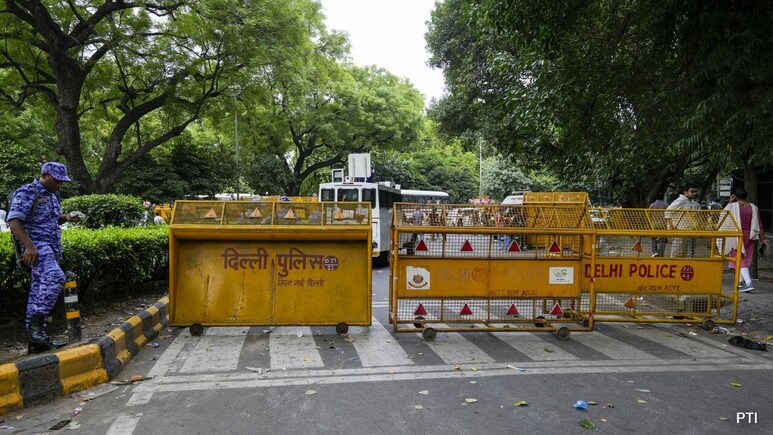
New Delhi, July 19: Ahead of the Monsoon Session of Parliament, security has been significantly tightened across the national capital as Delhi Police imposed prohibitory orders under Section 163 of the Bharatiya Nagarik Suraksha Sanhita (BNSS), restricting public gatherings in the New Delhi district.
The move comes in response to the Cockroach Janta Party’s (CJP) announcement of its proposed “Chalo Sansad” march on Monday. The party has called for the protest over alleged irregularities in the NEET medical entrance examination and is demanding the resignation of Union Education Minister Dharmendra Pradhan.
Issuing a public advisory, Deputy Commissioner of Police (DCP) Sachin Sharma clarified that no permission had been sought or granted for the proposed march towards Parliament. He stated that prohibitory orders are already in force and warned people against participating in any unauthorised gathering.
According to the advisory, protest marches, demonstrations, processions and assemblies of five or more people are strictly prohibited across the New Delhi district, except at the designated protest site at Jantar Mantar and only with prior approval from the authorities.
The Delhi Police also cautioned that anyone violating these restrictions could face prosecution under Section 223 of the Bharatiya Nyaya Sanhita (BNS) and other relevant legal provisions. Authorities appealed to citizens to cooperate with law enforcement, follow the restrictions, and help maintain public peace and security.
To prevent any disruption during the Parliament session, an extensive security plan has been put into action across the capital. Additional police personnel have been deployed, barricades have been strengthened, and vehicle checks have been intensified at major entry points into New Delhi.
Police sources said the CJP had not received official permission to organise a march towards Parliament and stressed that any attempt to enter the high-security zone without authorisation would not be allowed. Preventive deployment will continue throughout the Parliament session to ensure law and order is maintained.
Several important locations, including Parliament Street, Central Vista, Connaught Place, Shankar Chowk and surrounding government establishments, have been placed under heightened security. Multi-layered barricades, anti-sabotage inspections, enhanced CCTV surveillance and round-the-clock police patrolling have been introduced across sensitive areas in New Delhi, Central Delhi and parts of North Delhi.
Officials said every vehicle entering the New Delhi district is being thoroughly screened. Additional police pickets have been established at strategic points, while reserve forces and rapid response teams have been kept on standby to handle any emergency situation.
Security around Jantar Mantar, the designated protest site, has also been strengthened with a three-tier security arrangement. Two layers of Delhi Police personnel and one layer of paramilitary forces have been deployed to monitor the area continuously and prevent any untoward incident.
Meanwhile, the protest movement continues to gain attention. CJP founder Abhijeet Dipke remains on an indefinite hunger strike, while environmentalist and education reform activist Sonam Wangchuk, who was shifted to Safdarjung Hospital after his health deteriorated, has appealed to supporters from the hospital to participate peacefully in the proposed Parliament march.
With Parliament set to begin its Monsoon Session, the administration remains on high alert as authorities prepare to manage both legislative proceedings and the possibility of large-scale demonstrations in the heart of the national capital.
News source: Information for this article was gathered from a variety of reliable news outlets.