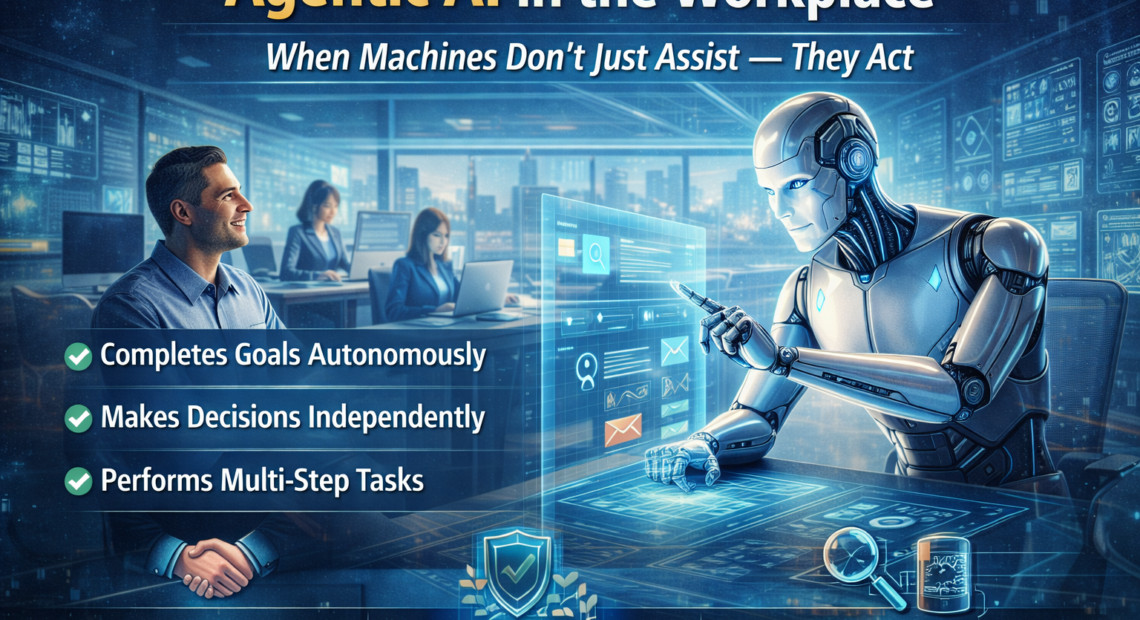
Agentic AI in the Workplace: When Machines Don’t Just Assist They Act
Agentic AI in the Workplace – For years, artificial intelligence has quietly supported the modern workplace — helping employees draft emails, analyse data, automate repetitive tasks, and improve productivity. But a new generation of AI is beginning to change the rules entirely.
Welcome to the era of Agentic AI.
Unlike traditional AI tools that simply respond to commands, Agentic AI systems are designed to take initiative, make decisions, and complete tasks autonomously. In simple terms, they don’t just wait for instructions — they actively work toward goals.
This shift is redefining how businesses operate and how employees interact with technology.
From Assistants to Autonomous Workers
Earlier AI systems functioned like digital assistants. Employees would ask them to summarise reports, generate presentations, or analyse spreadsheets. The AI responded — but the human remained fully in control.
Agentic AI changes that dynamic.
These systems can now perform multi-step tasks independently. For example, an AI agent could analyse sales data, identify trends, prepare a report, schedule a meeting with stakeholders, and even draft an email summarising the findings — all without continuous human input.
Companies developing advanced AI platforms, including OpenAI, Microsoft, and Google, are already exploring how such intelligent agents can be integrated into everyday workflows.
A New Kind of Colleague
For many workers, this evolution may feel like gaining a digital colleague rather than simply using software.
Imagine a marketing professional who assigns an AI agent to monitor market trends, analyse competitor campaigns, generate weekly reports, and suggest new strategies. Meanwhile, a project manager could rely on AI agents to coordinate schedules, track deadlines, and flag potential risks before they escalate.
The idea is not necessarily to replace human employees but to augment human capabilities — allowing people to focus more on creativity, decision-making, and strategic thinking.
Opportunities and Concerns
While the potential benefits are significant, the rise of Agentic AI also raises important questions about workplace dynamics.
If AI agents can independently perform complex tasks, what happens to traditional roles that rely heavily on repetitive processes? Some experts believe that many jobs will evolve rather than disappear, with workers shifting toward higher-value responsibilities.
There are also concerns about accountability. If an AI system makes a decision that affects business outcomes, who takes responsibility — the employee, the company, or the technology provider?
Organizations are already discussing frameworks for ethical AI governance, transparency, and human oversight to ensure these powerful systems remain safe and reliable.
The Future of Work
What is clear is that Agentic AI represents a major step in the evolution of workplace technology. Just as the internet transformed communication and cloud computing reshaped data access, autonomous AI systems could redefine productivity itself.
In the coming years, employees may increasingly collaborate not just with human colleagues but with intelligent digital agents that work around the clock.
The workplace of the future might not simply be human plus machine — it may become a truly collaborative ecosystem where both learn, adapt, and innovate together.
And as Agentic AI continues to evolve, the most successful organizations may be those that learn how to work with these intelligent systems rather than compete against them.
News Source : Information for this article was gathered from a variety of reliable news outlets.