Woman Biker Hit, Air Force Veteran Attacked: The Lawlessness In Gurugram
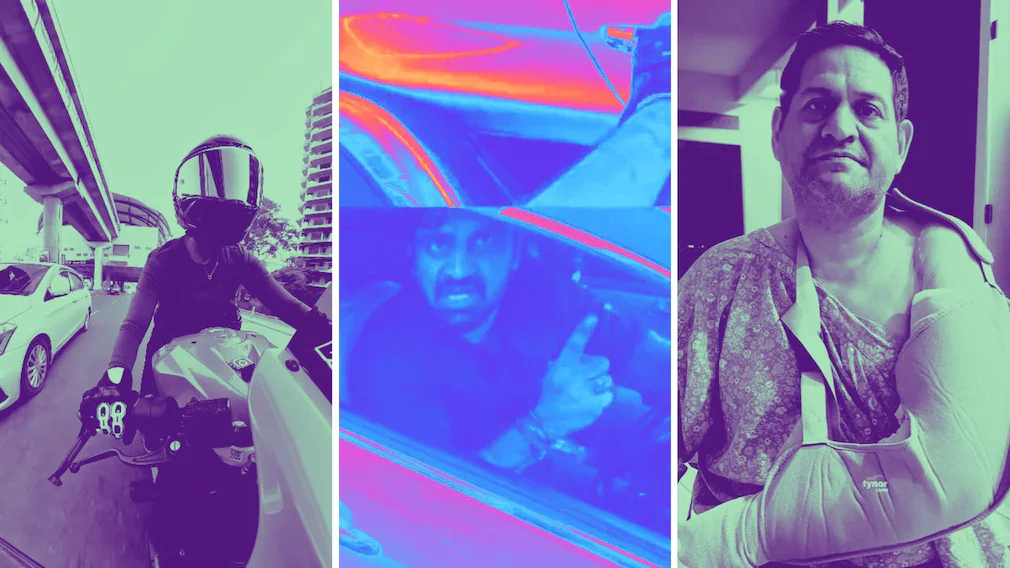
What makes some people in Gurugram feel so confident about breaking the law in broad daylight — even when they know they could be caught on camera?
That is the uncomfortable question hanging over a series of incidents in the Millennium City, where ordinary people have increasingly found themselves at the receiving end of road rage, violence and blatant disregard for the law.
CCTV cameras, dashcams and action cameras may record what happens. Police may eventually identify the accused. Yet, for those on the receiving end, that offers little comfort in the moment when an argument can turn into an assault or a routine drive can suddenly become a fight for survival.
Two incidents reported within days of each other have once again brought the issue into sharp focus.
The first involved Group Captain Amit Kumar Gupta (retired), a former Indian Air Force officer who was part of the Operation Safed Sagar team during the 1999 Kargil War.
Gupta had taken his family out for dinner at a restaurant in Gurugram. After dropping them off, he went to park the car himself. What should have been an ordinary part of an evening out ended with him being rushed for medical treatment with a fractured elbow and a serious head injury that required surgery.
According to his police complaint, parking staff first directed him from the valet area to the basement and then to a multilevel parking lot. He alleged that they subsequently refused to park his vehicle.
When Gupta tried to reverse the car, a parking attendant allegedly hit the windshield. Gupta got out of the vehicle to ask what was happening. The confrontation escalated, and he alleged that the attendant attacked him with an iron rod and threatened to kill him.
What reportedly followed was equally disturbing.
Gupta alleged that security personnel did not intervene and that the police took more than 30 minutes to arrive. According to him, it was a restaurant chef — rather than the security personnel responsible for managing the parking area — who finally stepped in.
Three days later, another incident on a Gurugram road showed just how quickly an ordinary evening can turn frightening.
Sia, who runs the Instagram account ‘rebelwheels_sia_’, was riding with her biking group on Golf Course Road when a car carrying several men began following her. She said the men appeared to be drunk and repeatedly asked her to stop.
She kept riding.
One of her friends stayed behind her, attempting to prevent the car from getting close. But the situation became dangerous when the car allegedly cut in front of Sia’s motorcycle, struck it and sped away.
Sia was thrown onto the road. Her motorcycle was dragged for several metres.
The entire incident was captured by an action camera mounted on her bike.
One of her friends managed to chase the car and caught up with it at a traffic signal. But the driver allegedly sped away again.
Sia later shared the vehicle’s registration number and the name of its registered owner online. Social media users have since been tagging the Gurugram Police and demanding action.
For anyone watching the footage, the incident raises a simple question: what could have happened if there had been no camera?
And these are not isolated concerns.
Around six months earlier, retired Army officer Colonel Anil Yadav was allegedly assaulted following a road accident in Gurugram.
Yadav was travelling to a wedding when his car collided with another vehicle. He got out to inspect the damage. According to his account, several men then pulled him out of his car and assaulted him.
They allegedly smashed the car’s windows and headlights with beer bottles and took Rs 30,000 from him.
Yadav said he repeatedly told the men that he accepted there had been an accident and was willing to pay for the damage. He also told them that he was an Army veteran.
According to Yadav, the response from the men was chilling. They allegedly told him they did not care about the military.
For someone who had spent years serving the country, being told that his service meant nothing in a confrontation on the road must have been deeply disturbing.
These incidents point towards a larger problem that goes beyond individual cases.
Gurugram has transformed at astonishing speed. In barely a few decades, farmland has given way to glass towers, corporate offices, luxury apartments, shopping complexes and wide roads packed with traffic.
But the city’s rapid physical growth has not always been matched by a comparable sense of civic discipline or public safety.
The result is a strange contradiction.
From the upper floors of Gurugram’s towering corporate buildings, the city can look like a symbol of India’s economic ambitions. Down on the roads, however, an entirely different reality can emerge — one where road rage, reckless driving, intimidation and violence can turn a normal day into a nightmare.
The problem becomes even more troubling when people begin to believe that they can get away with aggressive behaviour simply because they are powerful, connected, intoxicated or surrounded by others.
Road rage is hardly unique to Gurugram. Every major Indian city has its share of reckless driving and violent confrontations.
But that should not become an excuse to dismiss what residents experience.
A city cannot become genuinely global simply by building taller towers and wider roads. It also needs something much more basic: people should feel safe while using those roads.
A wide avenue should not create a false sense of security.
A person riding a motorcycle should not have to worry about being chased by a group of men.
A retired military officer should not have to fear being dragged out of his car after an accident.
And a former Air Force officer should not have to worry that asking a parking attendant a simple question could result in an attack with an iron rod.
There are also likely to be many incidents that never make it to social media or the news. Not everyone has an action camera. Not everyone knows how to make their complaint go viral. Not everyone has the energy, resources or influence to keep demanding answers after being victimised.
That raises another uncomfortable question: does justice become more accessible when an incident becomes viral?
It should not.
The police response should not depend on how much noise an injured person can create online.
The law should work just as effectively for the person with thousands of followers as it does for someone whose complaint will never make it beyond the local police station.
Gurugram’s problems are not limited to law and order either. The city has long struggled with civic infrastructure, traffic management and flooding. A place that markets itself as a global business hub can still grind to a halt after a heavy spell of rain, with flooded roads leaving expensive vehicles stranded.
That contrast says a lot about the city’s development.
Gurugram has built the skyline of a global city. Now it needs to build the everyday systems and civic culture that make a city worth living in.
People are not asking for miracles.
They are asking for the basics.
Safe roads. Quick police intervention. Accountability. Responsible driving. Respect for fellow citizens. And a simple assurance that if someone breaks the law in public, the law will actually catch up with them.
Because beneath the glass towers, luxury apartments and corporate headquarters, Gurugram is ultimately a city of ordinary people trying to get home safely.
They deserve nothing less.
News Source : Information for this article was gathered from a variety of reliable news outlets.