Supreme Court Judge Raises Serious Concerns Over Police Action at Jantar Mantar, Says Use of Force Is ‘Very Distressing’
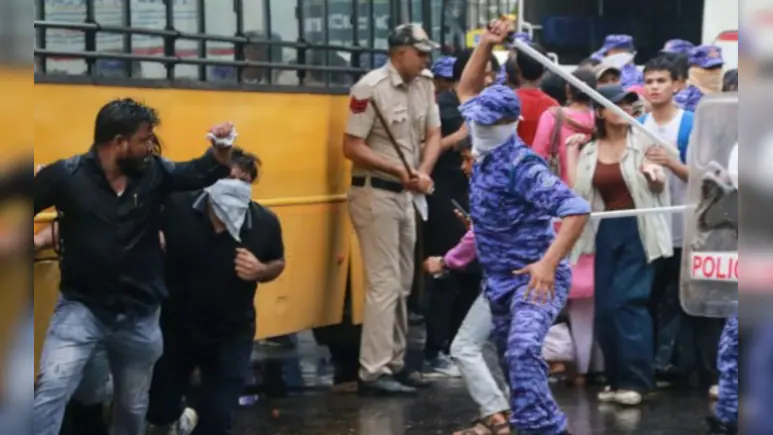
New Delhi: The conduct of police personnel during recent student protests at Delhi’s Jantar Mantar has come under fresh scrutiny after Supreme Court judge Justice Ujjal Bhuyan expressed strong concern over allegations of excessive force against demonstrators.
Speaking at the launch of retired IPS officer Yashovardhan Azad’s book Policing the Republic on Friday, Justice Bhuyan said it was deeply troubling to see young police officers personally involved in assaulting protesters.
He emphasised that police officers are expected to maintain a degree of professional detachment while dealing with demonstrations and stressed that the disappearance of such restraint should be a matter of serious concern.
Justice Bhuyan: Police must maintain restraint
Justice Bhuyan said citizens generally look towards the police when they feel threatened, wronged or vulnerable. Because of this, he said, maintaining public confidence in the police force is extremely important.
He pointed out that for an ordinary citizen, a police officer on the street represents the authority and power of the state. That authority, he said, must be exercised responsibly and within the boundaries of the law.
The judge questioned the need for excessive force when effective policing can be carried out without violating people’s fundamental rights.
He also expressed concern over reports and images of police personnel using force against young protesters.
Justice Bhuyan described it as “very, very distressing” to see young officers of the Indian Police Service allegedly participating personally in assaults against demonstrators.
According to him, the role of the police should be to enforce the law while maintaining professionalism and restraint, rather than becoming directly involved in physical confrontations with citizens.
Jantar Mantar protests under Supreme Court scrutiny
The remarks come against the backdrop of controversy surrounding police and paramilitary action during student protests at Jantar Mantar and the subsequent march towards Parliament.
The protests on July 20 have triggered allegations of excessive use of force by security personnel.
Various complaints have been raised regarding the manner in which protesters were handled during the demonstrations. The allegations include the use of lathis, tear gas, pellet guns and electronic batons, as well as claims of targeted harassment and alleged molestation of women protesters.
The matter eventually reached the Supreme Court, which has constituted a high-level panel to examine the allegations.
The panel is headed by former Supreme Court judge Justice R Subhash Reddy and has been tasked with examining the circumstances surrounding the police action.
Panel to examine CCTV and video evidence
The inquiry panel is expected to examine available CCTV recordings and other video footage relating to the clashes.
The purpose of the investigation is to establish what happened during the protests and determine whether the force used by the police was excessive or justified under the circumstances.
The panel’s examination is particularly significant because video recordings from protests can help establish the sequence of events and identify the actions of both protesters and security personnel.
The investigation will also look into allegations concerning the treatment of women protesters, including claims of targeted harassment and molestation.
Judge raises broader concerns about police credibility
Justice Bhuyan’s comments were not limited to the Jantar Mantar incident.
He spoke more broadly about the responsibility of police forces in a constitutional democracy and the importance of maintaining public trust.
He said citizens should be able to approach the police without fear and should have confidence that their complaints will be dealt with fairly.
According to the judge, the credibility of the police is essential because the force represents the authority of the state at the ground level.
When that authority is perceived to be misused, it can seriously damage public confidence in law enforcement institutions.
Custodial torture and deaths also a concern
Justice Bhuyan also spoke about the continuing concern over custodial torture and deaths.
He described custodial death as one of the gravest forms of wrongdoing in a society governed by the rule of law.
The judge stressed that citizens do not lose their fundamental rights simply because they have been arrested by the police.
He said any form of torture or cruel, inhuman or degrading treatment is unacceptable, whether it takes place during investigation, interrogation or another stage of police custody.
His remarks underline the constitutional principle that law-enforcement agencies must themselves remain within the law while exercising state power.
‘Government functionaries cannot become lawbreakers’
Justice Bhuyan also warned about the consequences when government officials themselves violate the law.
He said that if those responsible for enforcing the law become lawbreakers, it can encourage contempt for legal institutions and contribute to a broader culture of lawlessness.
In a democratic system, he said, government authority must always remain subject to the rule of law.
The observation assumes particular importance in cases involving police misconduct because the police are entrusted with enforcing laws and protecting citizens.
Any allegation that officers themselves have violated legal or constitutional safeguards, therefore, requires serious and independent scrutiny.
Concerns over ‘fake encounters’
Justice Bhuyan also touched upon the controversial issue of extra-judicial killings, commonly referred to as “fake encounters”.
He referred to the Supreme Court’s earlier observations on such incidents and said the court has taken a serious view of allegations involving staged encounters.
The judge cited a 2011 Supreme Court judgment in which the court had observed that fake encounters undermine the very foundation of the rule of law.
He stressed that an “encounter philosophy” cannot become part of legitimate policing.
According to Justice Bhuyan, policing must remain grounded in law and constitutional safeguards, regardless of the circumstances.
Balancing law and citizens’ rights
The judge’s remarks highlight a difficult balance that police forces face while dealing with protests and large public gatherings.
Authorities have a responsibility to maintain public order and prevent violence. At the same time, protesters and ordinary citizens retain their legal and constitutional rights.
The challenge for law enforcement is therefore to maintain order without resorting to unnecessary or disproportionate force.
Justice Bhuyan’s comments suggest that professional restraint, accountability and respect for fundamental rights must remain central to policing.
Supreme Court panel’s findings awaited
The controversy surrounding the Jantar Mantar protests is now expected to receive closer scrutiny through the Supreme Court-appointed panel.
The inquiry will examine the allegations against the police and review available evidence, including CCTV footage and videos of the clashes.
Its findings could help establish the sequence of events and determine whether the allegations of excessive force have merit.
For protesters, the inquiry represents an opportunity to have their complaints independently examined. For the police, it provides an avenue for the circumstances surrounding their actions to be assessed on the basis of evidence.
Justice Bhuyan’s comments have added considerable weight to the ongoing debate over police accountability.
At the heart of the issue is a fundamental question: how can the state maintain public order while ensuring that the people entrusted with enforcing the law continue to respect the law themselves?
The Supreme Court’s scrutiny of the Jantar Mantar episode, along with Justice Bhuyan’s broader observations on custodial violence, police conduct and fake encounters, has once again placed police accountability and citizens’ rights at the centre of public discussio
News source: Information for this article was gathered from a variety of reliable news outlets.