RBI Issues Compounding Order in BPTP FEMA Case, Company and Directors to Pay Rs 4.84 Crore
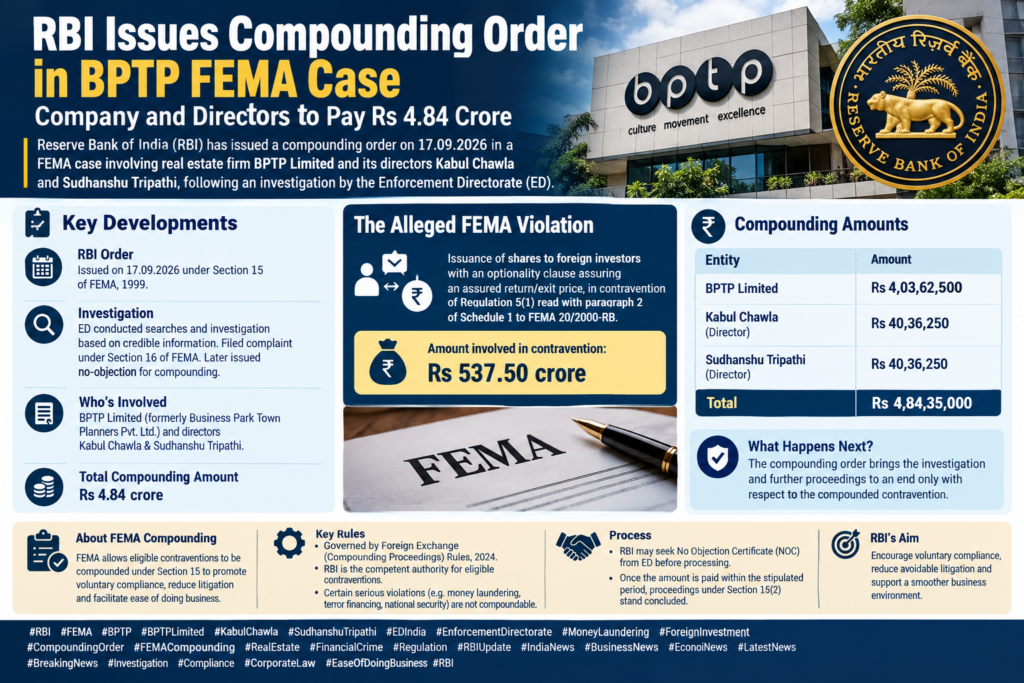
The Reserve Bank of India (RBI) has issued a compounding order in a Foreign Exchange Management Act (FEMA), 1999 case involving real estate company BPTP Limited and its directors Kabul Chawla and Sudhanshu Tripathi.
The order was issued on September 17, 2026, under Section 15 of FEMA after the Enforcement Directorate (ED) completed its investigation and filed a complaint before the Adjudicating Authority. The ED subsequently issued its no-objection for compounding of the eligible contravention.
The case relates to the alleged issuance of shares by BPTP to foreign investors with an optionality clause that assured them a return or exit price. According to the ED, this was in violation of the applicable FEMA regulations governing foreign investment.
The amount involved in the contravention was Rs 537.50 crore.
Following the ED investigation, BPTP and its directors filed applications with the RBI seeking compounding of the contravention under Section 15 of FEMA.
RBI Imposes Compounding Amount
Based on the ED’s no-objection, the RBI compounded the contravention through its order dated September 17.
BPTP Limited has been directed to make a one-time payment of Rs 4,03,62,500, while directors Kabul Chawla and Sudhanshu Tripathi have each been directed to pay Rs 40,36,250.
The combined compounding amount comes to Rs 4,84,35,000.
The compounding order brings the investigation and further proceedings to an end only in relation to the specific FEMA contravention that has been compounded.
What Was the FEMA Violation?
The ED’s investigation concerned the issuance of shares to foreign investors with an optionality clause that allegedly provided an assured return or exit price.
Such an arrangement was found to be in contravention of Regulation 5(1), read with paragraph 2 of Schedule 1 to FEMA 20/2000-RB, as applicable to the transaction.
The ED had earlier investigated the matter under FEMA after receiving information regarding the alleged violations and subsequently filed a complaint under Section 16 of the Act before the Adjudicating Authority.
How Does FEMA Compounding Work?
FEMA allows eligible contraventions to be compounded under Section 15. The mechanism is intended to facilitate voluntary compliance, reduce prolonged litigation and allow eligible cases to be resolved through payment of a prescribed compounding amount.
Under the Foreign Exchange (Compounding Proceedings) Rules, 2024, the RBI is the competent authority to compound eligible contraventions falling within its jurisdiction.
Certain serious violations are not eligible for compounding, including specified cases involving suspected money laundering, terror financing or matters affecting the sovereignty and integrity of India.
Where required, the RBI may seek a no-objection certificate from the ED before processing a compounding application.
Once the prescribed compounding amount is paid within the stipulated period, proceedings relating to the compounded contravention are concluded under Section 15(2) of FEMA.
The ED has said that such a mechanism can help encourage voluntary compliance, reduce avoidable litigation and support ease of doing business.
In the BPTP case, the ED’s investigation and related proceedings have been closed only with respect to the contravention that was compounded by the RBI.
News Source : Information for this article was gathered from a variety of reliable news outlets.