Modi 3.0 Cabinet Reshuffle: 12 Vacancies, New Faces and Election Strategy in Focus
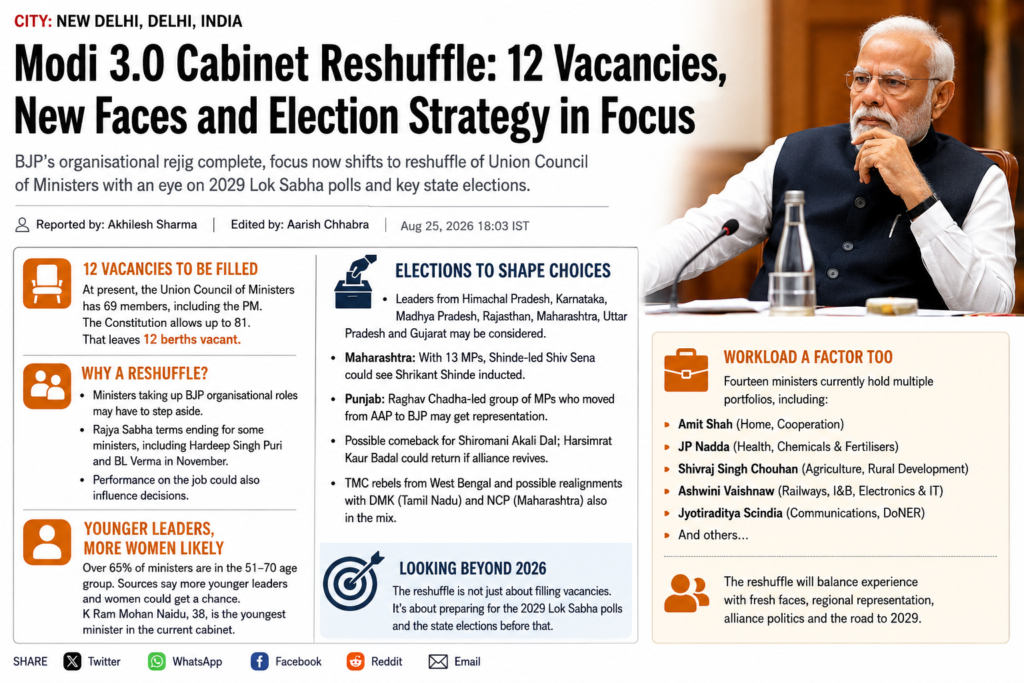
New Delhi : The BJP has completed its latest organisational changes, and attention has now shifted to a possible reshuffle of Prime Minister Narendra Modi’s Union Council of Ministers. Sources indicate that the exercise could bring in younger leaders, new allies and representatives from states where elections are approaching.
At present, the Union Council has 69 members, including the Prime Minister, while the Constitution allows up to 81 ministers. This leaves 12 positions vacant, giving the government considerable room to make changes.
Why a reshuffle is being considered
Several developments could trigger changes in the cabinet. Some ministers have recently taken up important responsibilities within the BJP, while others are nearing the end of their parliamentary terms. The party generally follows the principle of “one person, one role”, which could mean that ministers who have moved into organisational positions may have to step aside.
Among those who have recently taken party responsibilities are Harsh Malhotra, now Delhi BJP chief, and Pankaj Chaudhary, who has been appointed Uttar Pradesh BJP chief.
There are also ministers whose Rajya Sabha terms are nearing their end. Petroleum Minister Hardeep Singh Puri and Minister of State BL Verma are due to complete their current terms in November.
Performance could be another consideration, with some ministers potentially being moved out or reassigned.
Younger leaders and women may get more representation
Age is also expected to play a role. Several ministers in the current government are above 70, while the youngest minister is Civil Aviation Minister K Ram Mohan Naidu, who is 38.
Sources suggest that the reshuffle could give greater space to younger leaders and women, while also taking into account political and regional representation.
Elections likely to influence the choices
With several state elections due before the 2029 Lok Sabha election, political considerations are expected to be important.
Leaders from Himachal Pradesh and Karnataka, both ruled by the Congress, could be considered. Madhya Pradesh, Rajasthan, Maharashtra and Uttar Pradesh are also being watched closely. Gujarat, Prime Minister Modi’s home state, will also head towards elections by the end of next year.
Maharashtra could receive particular attention. The Shiv Sena led by Deputy Chief Minister Eknath Shinde now has 13 MPs, and his son Shrikant Shinde is among the names being discussed for a possible cabinet position.
Punjab is another important factor. A group of Rajya Sabha MPs associated with Raghav Chadha has moved from the Aam Aadmi Party towards the BJP, and their inclusion could help the BJP ahead of the Punjab Assembly election.
There is also speculation about a possible revival of the BJP’s alliance with the Shiromani Akali Dal. If that happens, former Union minister Harsimrat Kaur Badal could once again become an important figure in the government.
More allies could find a place
The BJP may also consider accommodating leaders from other parties that have moved closer to the NDA.
Some Trinamool Congress rebels from West Bengal who have shifted political allegiance could be considered for ministerial positions. There is also speculation about possible political realignments involving the DMK in Tamil Nadu and the NCP in Maharashtra, although these possibilities remain uncertain.
Reducing the workload of senior ministers
The reshuffle may not only be about political equations. The workload of several senior ministers could also be redistributed.
At present, a number of ministers handle multiple ministries. Home Minister Amit Shah, for example, also oversees Cooperation, while Ashwini Vaishnaw handles Railways, Information and Broadcasting, and Electronics and IT. Other ministers, including Shivraj Singh Chouhan, Manohar Lal, Jyotiraditya Scindia and Kiren Rijiju, also manage more than one portfolio.
A reshuffle could therefore be aimed at creating a better division of responsibilities while preparing the government and BJP for the next round of elections.
Overall, the possible cabinet changes appear to be about more than simply filling vacant posts. Age, performance, regional representation, alliance politics, organisational responsibilities and the 2029 Lok Sabha election are all likely to shape Modi 3.0’s next team.
News source: Information for this article was gathered from a variety of reliable news outlets.