Eight Years After Trader Joe’s Tragedy, Gunman Convicted on 40 Charges but Cleared of Murder
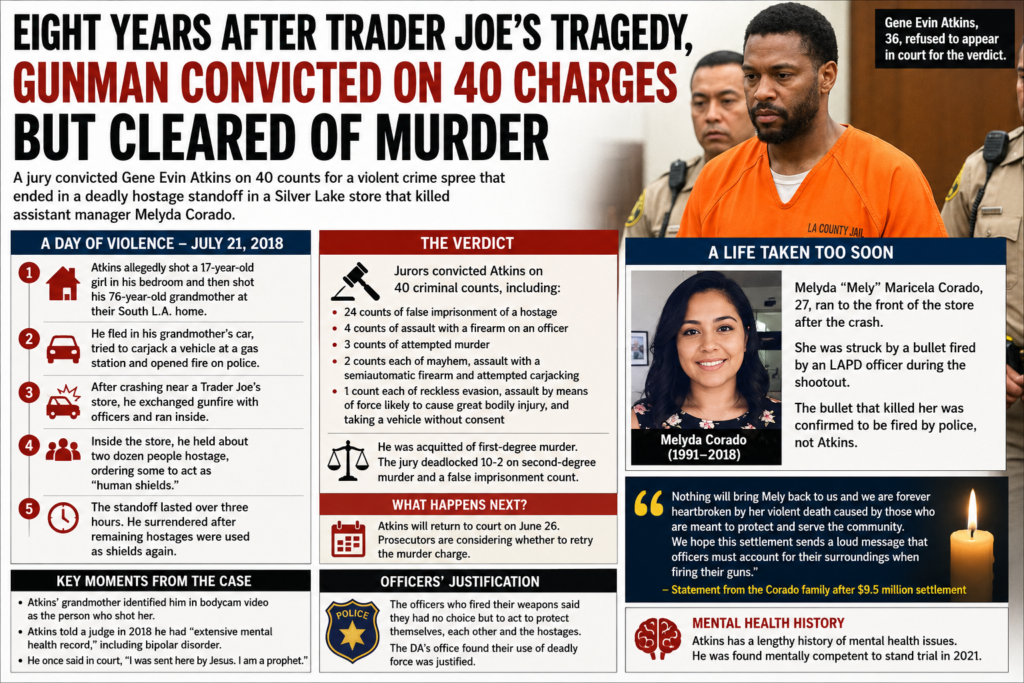
Nearly eight years after a tragic hostage standoff at a Trader Joe’s store in Los Angeles claimed the life of a beloved employee, a jury has convicted Gene Evin Atkins on 40 criminal charges but stopped short of finding him guilty of murder.
Atkins, now 36, was at the center of a violent crime spree on July 21, 2018, that began with the shooting of a teenage girl and his grandmother before escalating into a dramatic police chase and hostage situation inside a Silver Lake Trader Joe’s.
During the chaos, 27-year-old assistant store manager Melyda “Mely” Corado was fatally struck by a bullet fired by a police officer during an exchange of gunfire outside the store. While prosecutors argued that Atkins’ actions directly created the deadly situation that led to her death, jurors acquitted him of first-degree murder and were unable to reach a unanimous verdict on a second-degree murder charge.
The jury found Atkins guilty of numerous offenses, including hostage-taking, attempted murder, assault on police officers, attempted carjacking, reckless evasion of police, and other violent crimes connected to the incident.
According to prosecutors, the violence began when Atkins allegedly shot a 17-year-old girl and his 76-year-old grandmother before fleeing in a vehicle. Authorities said he later attempted a carjacking, exchanged gunfire with police, and stormed into the Trader Joe’s store, where dozens of frightened customers and employees were trapped for hours.
Witnesses testified that some hostages were forced to act as human shields during the standoff. Corado, who had rushed toward the front of the store after hearing the commotion, was caught in the crossfire and suffered fatal injuries.
The standoff ended more than three hours later when Atkins surrendered to police. Investigators later confirmed that the bullet that killed Corado was fired by an LAPD officer, not Atkins. However, prosecutors pursued murder charges under California’s “provocative act” doctrine, arguing that Atkins set in motion the chain of events that resulted in her death.
The case also drew attention to Atkins’ long history of mental health struggles. Court records show he had previously spoken about being diagnosed with bipolar disorder and other mental illnesses. Despite those concerns, he was ultimately found mentally competent to stand trial.
Corado’s family later reached a multi-million-dollar settlement with the City of Los Angeles over her death but has continued to honor her memory and advocate for greater accountability during police operations.
Atkins is scheduled to return to court later this month as prosecutors decide whether to retry the unresolved murder charge.
News source: Information for this article was gathered from a variety of reliable news outlets.