BJP MP’s “Father’s House” Remark on E20 Petrol Sparks Controversy
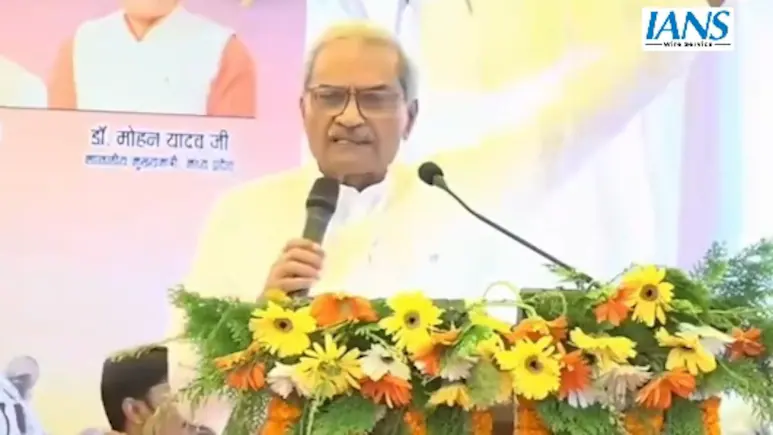
Rewa: A fresh political controversy has erupted over India’s E20 petrol policy after BJP MP Janardan Mishra made a sharp remark while defending the government’s decision to promote ethanol-blended fuel.
Speaking at an event in Rewa on Sunday to mark the launch of new flight services connecting the city with Bhopal and Kolkata, Mishra questioned critics who are demanding the continued availability of pure petrol.
“Will pure petrol come from your father’s house?” the BJP MP said while addressing those opposing ethanol blending.
Mishra argued that India remains heavily dependent on imported crude oil and that the country needs to reduce its dependence on overseas supplies. According to him, India produces only around 20 per cent of its oil domestically, while nearly 80 per cent is imported.
He linked the need for alternative fuel options to the current geopolitical situation, particularly disruptions around the Strait of Hormuz. The narrow waterway between Iran and Oman is a crucial route for global energy shipments, and tensions in the region have raised concerns over the movement and cost of crude oil.
Mishra Defends Ethanol Blending
The BJP leader said the government’s decision to increase ethanol blending in petrol should be viewed in the context of India’s energy requirements and dependence on imports.
He questioned what alternatives critics were proposing if the country could not rely entirely on imported crude oil.
Mishra said that when Prime Minister Narendra Modi speaks about blending 20 per cent ethanol with petrol, some people oppose the policy and insist that consumers should receive only pure petrol.
He argued that India needs to explore domestically available alternatives instead of depending entirely on imported fuel.
Comparison With Brazil
While making his case for ethanol, Mishra also referred to Brazil, where ethanol is widely used as a vehicle fuel.
He claimed that vehicles in Brazil can operate on fuel containing very high levels of ethanol and argued that ethanol-based fuels do not necessarily create problems for vehicles.
The BJP MP further said that automobile manufacturers have developed engines capable of handling ethanol-blended petrol and that Indian vehicles can operate on ethanol-based fuel.
“Indian vehicles will run and can run on ethanol,” he said, defending the Centre’s policy.
E20 Debate Continues
The remarks come amid an ongoing debate in India over E20 petrol, which contains up to 20 per cent ethanol blended with petrol.
The government has promoted ethanol blending as part of its efforts to reduce crude oil imports, improve energy security and support the domestic ethanol industry. However, the policy has also faced criticism from some political leaders and vehicle owners, particularly over concerns about fuel efficiency, compatibility with older vehicles and the long-term impact on engines and components.
The government has maintained that vehicles designed or certified for E20 can safely use the fuel, while automobile manufacturers have also been assessing compatibility across different vehicle models.
Political Row Over Remark
Mishra’s comments are likely to add fuel to the political debate surrounding E20 petrol. His “father’s house” remark has drawn attention because of its confrontational tone, even as he attempted to explain the economic and strategic reasons behind ethanol blending.
The BJP MP maintained that India cannot ignore its dependence on imported crude and must look for alternatives that can reduce pressure on the country’s import bill.
He also pointed to the wider economic benefits of developing domestic fuel alternatives, arguing that greater use of ethanol could support local production and employment.
The E20 debate is therefore increasingly being framed around two competing concerns: India’s push for energy independence and the questions being raised by consumers over the practical impact of higher ethanol content in petrol.
As the government continues its transition towards higher ethanol blending, the political debate over fuel policy is expected to remain intense, with supporters highlighting energy security and critics continuing to raise concerns about vehicle performance, mileage and consumer costs.
News source: Information for this article was gathered from a variety of reliable news outlets.