Pantomath Under the Scanner: Investment Bank Faces Questions Over Related-Party Deals and Investor Losses
Mumbai | October 8, 2026
A series of transactions involving Mumbai-based investment banking firm Pantomath has raised questions about potential conflicts of interest, transparency and investor protection in India’s rapidly expanding capital markets. The concerns centre on the group’s business structure, where investment funds associated with Pantomath have invested in companies that were later taken public or offered shares to investors through the same group’s investment banking operations.
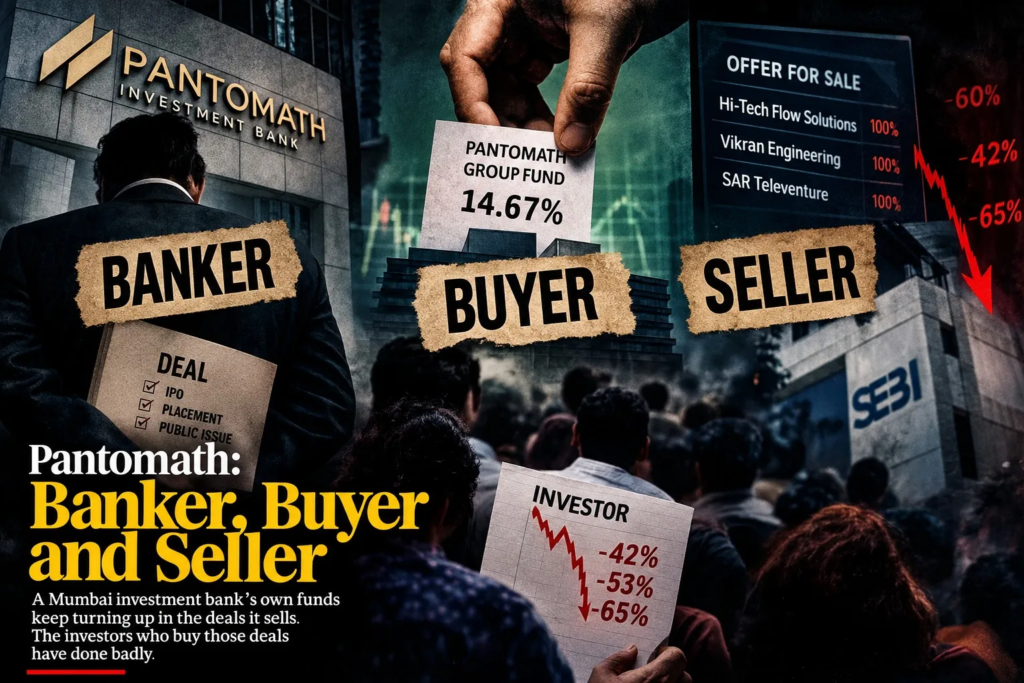
An investigation published by Businessworld highlights how funds linked to Pantomath have participated in corporate deals before the investment bank subsequently helped bring those companies to the public market. While such arrangements are not necessarily illegal, the transactions have drawn attention because investors who purchased shares in several of these companies at their offer prices have suffered significant losses.
According to the report, investors in three recent deals have seen their investments decline by approximately 42% to 65% from their respective offer prices. This has raised concerns about whether sufficient safeguards exist when different businesses operating under the same corporate group participate on opposite sides of a transaction.
Hi-Tech Flow Solutions IPO Raises Fresh Questions
One of the latest examples involves Delhi-based pipe manufacturer Hi-Tech Flow Solutions, which has filed preliminary documents for an initial public offering (IPO) with the Securities and Exchange Board of India (SEBI). Pantomath is one of the two investment banks appointed to manage the proposed public issue.
A fund associated with the Pantomath group reportedly holds a 14.67% stake in the company. The investment was made at ₹19.74 per share, and the fund plans to sell its entire holding of approximately 20.3 million shares through the IPO.
The development has attracted attention because Pantomath would be involved in marketing the public offering while a fund from its own group is seeking to exit its investment.
The issue also has a connection with another company controlled by the same Bansal family. In October 2024, Pantomath acted as the sole banker when listed company Hi-Tech Pipes raised ₹500 crore through a share placement at ₹185.50 per share.
A Pantomath-associated fund participated in that transaction, purchasing approximately 2.7 million shares worth nearly ₹50 crore. However, by September 21, 2026, the company’s shares had fallen to ₹75, representing a decline of around 60% from the placement price.
The situation has raised an important question about the relationship between investment banking operations and investment funds belonging to the same business group, particularly when retail investors are ultimately exposed to the risks.
Growing Presence in India’s IPO Market
India is witnessing an unprecedented wave of public offerings, with companies increasingly turning to the stock market to raise capital and provide exits to existing shareholders.
Pantomath has emerged as an active participant in this market, having managed 123 IPOs, according to the report. Founded by Mahavir Lunawat and Madhu Lunawat, the group has expanded beyond investment banking into pre-IPO investment funds, stockbroking and mutual fund operations.
The group also holds a 37% stake in a listed broking business and launched its mutual fund operations in July 2025. Its mutual fund business reportedly manages approximately ₹2,000 crore in assets.
Although several large financial institutions in India operate multiple businesses under one corporate umbrella, the report questions how frequently Pantomath’s different business divisions become involved in the same transactions.
The concern becomes more significant when such deals involve smaller companies, relatively low trading volumes and a large number of retail investors.
Vikran Engineering Deal Highlights Concerns
Another transaction examined in the report involves Vikran Engineering, a power infrastructure and engineering company.
In January 2024, a Pantomath-associated fund invested in the company during a funding round that valued the business at approximately ₹740 crore. Pantomath Capital reportedly acted as the exclusive investment banker for that transaction.
Around 19 months later, Pantomath co-led Vikran Engineering’s IPO, which valued the company at approximately ₹1,781 crore before the fresh issue of shares. Retail investors purchased the shares at ₹97 apiece.
The company’s stock initially attracted market attention following the announcement of a major solar power project worth ₹1,642 crore. However, the order was subsequently cancelled, and the company’s internal auditors resigned, adding to concerns surrounding its business performance.
Between September 2025 and June 2026, domestic institutional investors reduced their shareholding in Vikran Engineering from 12.6% to 5.7%. During the same period, the public shareholding increased from 28.8% to 36.7%, while the number of shareholders grew by approximately 17,000.
Shareholding information indicates that the Pantomath-associated fund may have reduced its holding by around 6%. However, Pantomath has stated that it sold less than 5% of its original investment.
SAR Televenture Shares Witness a Sharp Decline
SAR Televenture, a company operating in the telecom infrastructure sector, is another example highlighted in the investigation.
Pantomath brought the company to the stock market in 2023 through an IPO that raised less than ₹25 crore. Approximately eight months later, the company raised an additional ₹450 crore through a combination of fundraising activities.
This included a ₹150 crore follow-on public offering at ₹210 per share and a ₹300 crore rights issue at ₹200 per share.
The market-making responsibility was handled by the broking arm of Asit C Mehta, in which a Pantomath-associated company holds a part ownership.
SAR Televenture’s share price subsequently climbed to ₹414 within six weeks of the fundraising. However, the stock later witnessed a substantial decline and was trading around ₹73 at the time cited in the report.
Pantomath has maintained that its associated fund continues to hold its entire investment in the company.
IPO Performance Raises Questions About Investor Returns
The investigation also examined the overall performance of companies brought to the stock market by Pantomath.
According to data from IPO Platform, nearly 90% of the 123 IPOs managed by the investment bank listed at a premium. However, more than half of those companies are now trading below their respective IPO prices.
Among Pantomath’s eight most recent main-board IPOs, five were reportedly trading below their issue prices.
The report acknowledges that investing in smaller companies and SME IPOs involves substantial market risks, and that weak post-listing performance is not limited to any single investment bank. However, the losses suffered by investors in several Pantomath-associated transactions have brought the group’s business practices under greater scrutiny.
Earlier SEBI Action Against a Related Brokerage Firm
The investigation also revisits the regulatory history of Pantomath Stock Brokers, a brokerage firm whose board previously included the Lunawats.
Between 2016 and 2020, the brokerage reportedly acted as a market maker in 63 small-company IPOs, while Pantomath Capital managed all 63 public issues.
In 2022, SEBI identified serious irregularities during an inspection of the brokerage firm. The regulator found that client funds had allegedly been misused on 35 of the 37 days examined by its inspectors.
The findings included pledging clients’ shares beyond the amounts they owed and using client money to cover the firm’s own trading losses. The brokerage had reportedly stated that it was holding ₹32 crore worth of shares for SME market-making activities.
SEBI imposed a penalty of ₹20 lakh on the brokerage.
Pantomath has maintained that the Lunawats had already separated themselves from the brokerage by 2019 and attributed the operational issues to the Toshniwal family, which was managing its day-to-day operations.
However, the report notes that Pantomath continued using the brokerage as a market maker for two additional IPOs in 2021 and 2022. The older brokerage subsequently surrendered its exchange licence in July 2025, shortly after the group’s mutual fund received regulatory approval.
Pantomath described the timing as a coincidence.
The investigation also mentions a separate SEBI inspection of Pantomath Capital in 2023, during which discrepancies were identified in signatures appearing on two due-diligence certificates. The matter was dropped in 2024 without a final ruling on the signature-related issue.
Pantomath Defends Its Business Structure
Responding to the allegations and questions raised in the investigation, Pantomath stated that each of its businesses operates as a separate SEBI-registered entity with its own board of directors.
The company argued that integrated financial groups operating across investment banking, asset management and brokerage services are common in international financial markets, including New York and London.
Pantomath maintained that investments made by its group funds in companies handled by its investment banking division do not automatically create a regulatory conflict. It also stated that its investments remained within prescribed limits and were appropriately disclosed.
The company further clarified that its investment banking operations are required to sign due-diligence certificates regardless of their specific role in an IPO.
On questions regarding its Bharat Value Fund, Pantomath described the fund as a long-only investment vehicle focused on holding investments rather than frequent trading or short selling.
However, the report highlighted differences between this explanation and the fund’s promotional material, which reportedly referred to an exit through an IPO or sale within approximately three and a half years, targeting an average return of 2.5 times the original investment.
Pantomath did not provide a detailed list of other IPOs in which its associated funds had invested. It also did not specifically identify whether its mutual fund had purchased shares in any IPO managed by the investment banking division, stating that it was permitted to participate in such offerings.
Regulatory Framework and Investor Protection Under Discussion
The investigation has brought renewed attention to India’s regulatory framework governing potential conflicts of interest within financial institutions.
In the United States, investment banks face additional disclosure and independence requirements when their affiliated entities hold significant stakes in companies they are taking public. Independent underwriting arrangements may also be required to address concerns surrounding valuation and conflicts of interest.
In December, SEBI introduced restrictions preventing investment bankers from leading IPOs where their directors or employees hold even relatively small ownership interests in the issuing company.
However, the report points to a regulatory gap: while restrictions may apply to direct ownership by bankers, a fund belonging to the same corporate group can hold a substantially larger stake and sell its entire investment through a public offering handled by the group’s investment banking arm.
The Hi-Tech Flow Solutions IPO has therefore become an important example in the wider debate over whether existing regulations adequately address conflicts arising from relationships between affiliated financial businesses.
A Bigger Question for India’s Capital Markets
The central issue raised by the investigation is not simply whether Pantomath has violated any existing regulations. Rather, it concerns whether the current rules provide enough protection to investors when different businesses under one financial group participate in the same transaction.
Even when every individual entity operates under a separate licence and follows the applicable disclosure requirements, investors may still find it difficult to understand the commercial relationships behind a public offering.
When an investment fund buys shares in a company at an early stage and a related investment bank later manages its IPO, the interests of the fund, the issuing company and the incoming public investors may not always be identical.
As India’s IPO market continues to expand, stronger disclosures, greater transparency and independent scrutiny of related-party transactions could become increasingly important.
Pantomath has maintained that its activities are compliant with the existing regulatory framework. Nevertheless, the questions raised in the investigation highlight the need for investors to understand not only the company issuing shares but also the financial relationships of the institutions bringing those shares to the market.
The larger concern is clear: investors deserve complete transparency about who is selling shares to them, who is managing the public offering and whether both sides have financial connections that could influence the transaction.
News source: Information for this article was gathered from a variety of reliable news outlets.