3 Italians Leave Delhi Without Immigration Check, Air India Issued Notice
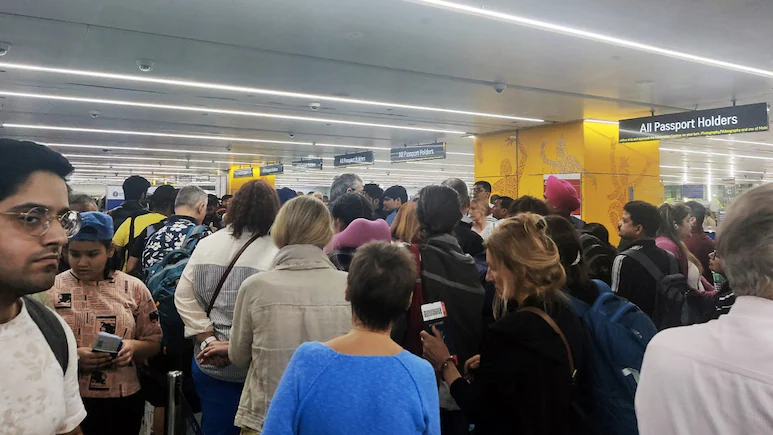
Three Italian nationals reportedly flew out of India from Delhi without completing the mandatory immigration clearance, exposing a serious lapse in passenger handling at the airport.
The passengers had arrived in Delhi from Amritsar on an Air India flight before connecting to a Lufthansa flight bound for Munich. The Ministry of Civil Aviation has now issued a show-cause notice to Air India and asked the airline to explain the lapse within seven days.
The incident took place in the early hours of September 4. The three passengers arrived in Delhi on Air India flight AI-1115 from Amritsar at around 12:50 am. Roughly an hour later, at about 1:45 am, they boarded Lufthansa flight LH-763 for Munich.
The problem was that they reportedly never went through immigration before leaving the country.
How Did The Passengers Bypass Immigration?
The three passengers were travelling under Air India’s hub-and-spoke model, in which travellers from smaller airports are flown to a major hub before connecting to an international flight.
In this case, they travelled from Amritsar to Delhi. At Amritsar, they were issued “D” category boarding passes for their Air India domestic flight. They were also reportedly given boarding passes for their onward Lufthansa flight to Munich.
This has become one of the key points questioned by the Ministry of Civil Aviation.
According to the ministry’s notice, Air India’s standard operating procedure recognises two categories of boarding passes — “D” for domestic passengers and “I” for international passengers. The ministry has questioned how the additional boarding passes for the international sector were issued at Amritsar.
Once the passengers reached Delhi, they should have been identified as international travellers and directed through the appropriate immigration process.
Instead, the ministry said they were taken from Gate 39 towards the International-to-International Transfer Area. They subsequently reached the departure area and boarded their Lufthansa flight without passing through the immigration checkpoint.
Five Air India SOP Provisions Flagged
The ministry has identified five provisions of Air India’s Domestic-International (DI) Operations SOP that it believes were not followed.
The first concerns the prescribed boarding-pass system, which provides for the use of D and I categories.
The second requires domestic and international passengers to be separated after disembarkation. According to the ministry, that segregation did not happen in this case.
The third provision states that access to the International-to-International Transfer Desk should be restricted to passengers carrying I-category boarding passes. The ministry has therefore questioned how the three passengers, who had D-category boarding passes for their domestic journey, were allowed into the area.
The remaining provisions concern Air India’s requirement to have a nodal officer and monitoring team at both hub and spoke airports around the clock.
These teams are responsible for monitoring passenger movement and ensuring that travellers do not accidentally or incorrectly enter the international departure process without completing the required formalities.
According to the ministry, that monitoring system failed to prevent the incident.
Ministry Seeks Answers From Air India
The show-cause notice has sought detailed explanations from the airline on how the passengers managed to enter the international transfer area despite holding D-category boarding passes.
Air India has also been asked why the passengers were not separated from domestic travellers after arriving in Delhi and why they were issued boarding passes for the Lufthansa flight while still at Amritsar.
The ministry has sought clarification on the role played by Air India employees as well as SATS personnel involved in handling and transferring the passengers.
It has also asked the airline to provide details about the designated nodal officer and monitoring team’s presence and actions at the time.
Another concern is why the required reconciliation of domestic and international passengers was not completed in time.
The ministry has also questioned whether the General Declaration, passenger manifest and API-PNR information concerning the three passengers were shared with immigration authorities within the required timeframe and whether their status was correctly reflected in the records.
At the heart of the matter is a simple but serious question: How did three passengers recorded as domestic travellers manage to board an international flight without triggering the mandatory immigration checks?
Lapse Detected During Manual Reconciliation
The ministry has also sought an explanation for why the discrepancy was not caught before the passengers left the country.
According to the notice, the problem was discovered later during a manual reconciliation process.
That detail raises questions about more than an individual employee’s actions. It also puts the spotlight on whether the systems designed to prevent such an occurrence are working as intended.
A passenger travelling from a domestic airport to an international destination through a hub should be seamlessly transferred into the correct immigration process. In this case, that safeguard appears to have broken down at multiple points.
Air India Given Seven Days To Respond
The Ministry of Civil Aviation has asked Air India to explain why action should not be taken against the airline for allegedly failing to follow its prescribed SOP and for not putting adequate safeguards in place.
The airline has been given seven days from the receipt of the notice to submit its response.
The ministry has warned that failure to respond within the stipulated period could be treated as the airline having no explanation to offer. Administrative and regulatory action may then be considered based on the available records.
What Is The Hub-And-Spoke Model?
The hub-and-spoke system is commonly used by airlines to connect passengers from smaller airports to international destinations.
For example, a passenger travelling from Amritsar to Munich may first take a domestic flight to Delhi and then connect to an international flight from the capital.
But once the passenger reaches the hub airport, the airline must correctly identify them as an international traveller and route them through the required immigration process.
The Delhi incident highlights what can happen when that chain of checks breaks down.
The three Italian nationals were able to move from the domestic arrival process into the international departure system and board a Munich-bound flight without completing immigration clearance.
The Ministry of Civil Aviation is now seeking answers from Air India over how such a significant procedural lapse was allowed to happen.
News Source : Information for this article was gathered from a variety of reliable news outlets.