

Pakistan Moves to Deepen Ties with Taliban-Led Afghanistan, Follows China’s Diplomatic Lead
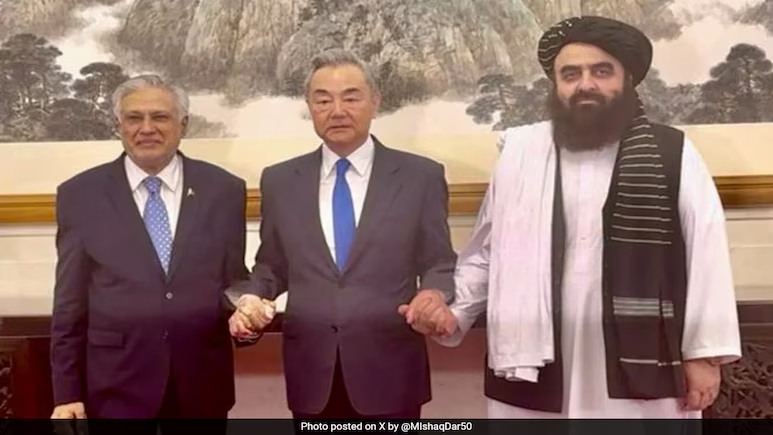
In a major diplomatic shift, Pakistan has announced plans to appoint an ambassador to Afghanistan for the first time since the Taliban seized control in 2021. The move signals a significant upgrade in Islamabad’s engagement with Kabul, just days after a high-level trilateral meeting hosted by China, which brought together top diplomats from China, Pakistan, and the Taliban administration.
The announcement was made by Pakistan’s Foreign Minister Ishaq Dar, who hailed the “positive trajectory” of relations between the two countries following recent dialogue. “I am confident this step would further contribute towards enhanced engagement and exchanges between two fraternal countries,” Dar said. While the name of the new envoy has not been revealed, the decision marks a shift from the current charge d’affaires-level diplomatic representation.
This development comes on the heels of back-to-back diplomatic efforts. Last month, Pakistan sent a delegation to Kabul for bilateral talks, and just last week, Beijing hosted a ministerial-level meeting where Chinese Foreign Minister Wang Yi, Ishaq Dar, and the Taliban’s acting Foreign Minister Amir Khan Muttaqi discussed regional cooperation.
China’s growing role in facilitating dialogue between Pakistan and the Taliban has been notable. Though Beijing has not officially recognized the Taliban regime, it was the first country to accept a Taliban-appointed ambassador in Kabul. China has now brought Afghanistan into the fold of the China-Pakistan Economic Corridor (CPEC)—a move that could shift regional dynamics, as the corridor passes through Pakistan-occupied Kashmir (PoK).
The backdrop to this renewed engagement, however, is far from smooth. Tensions between Islamabad and Kabul have been simmering since December 2024, when Pakistani airstrikes in Afghanistan’s Paktika province killed nearly 50 people. Pakistan alleges that militants launching attacks on its territory operate from Afghan soil, a claim Kabul firmly denies. In return, the Taliban administration has criticized Pakistan for the mass deportation of Afghan refugees and shifting blame for internal terrorism.
The global community continues to withhold formal recognition of the Taliban regime, citing serious concerns over human rights, particularly women’s rights. Yet, Pakistan’s decision to send an ambassador places it alongside China, the UAE, and Uzbekistan—countries that have all taken steps toward more formal engagement with the Taliban, even while maintaining that they do not officially recognize the administration.
Analysts see the ambassadorial move as “unofficially official,” potentially inching closer to broader recognition. For now, it marks a turning point in the complex and evolving ties between Islamabad and Kabul—under the watchful eye of Beijing and against the backdrop of shifting geopolitical interests in South Asia.
News Source : Information for this article was gathered from a variety of reliable news outlets.