

Inside the Crash: Air Force Pilot Dissects Air India Tragedy
New Delhi —
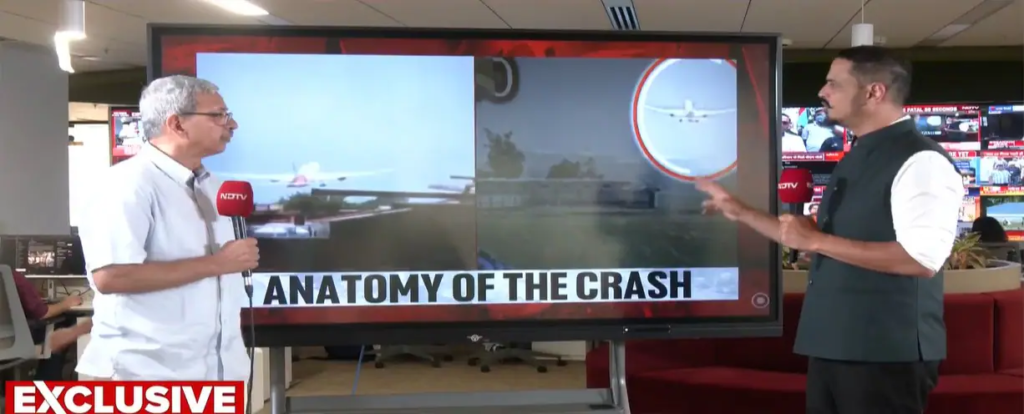
Veteran Indian Air Force pilot and aviation expert Captain Ehsan Khalid offered a detailed breakdown of the fatal Air India crash involving Flight AI171, a Boeing 787-8 Dreamliner. The flight, which was en route from Ahmedabad to London Gatwick, crashed shortly after takeoff on Thursday, leaving 241 dead and only one survivor.
What the Videos Reveal
Two crucial video clips — one 36 seconds long and another 59 seconds — show the plane ascending and then descending sharply before crashing into a residential area. Captain Khalid noted one striking detail: the landing gear remained deployed throughout the flight, something highly unusual unless pilots are dealing with extreme wind shear or have committed to a landing.
A 32-Second Window
From takeoff to crash, the entire sequence lasted just 32 seconds. Captain Khalid pointed out that the aircraft barely climbed beyond 200–250 feet. Normally, after takeoff, landing gear is retracted and flaps (used for lift at low speeds) are adjusted. But in this case, the aircraft lost lift — possibly due to a lack of speed or power — and began to descend rapidly.
No Control Jam
Dismissing the idea of a mechanical control jam, Captain Khalid emphasized that the aircraft was still being flown manually. In one video, the aircraft visibly pitches up, indicating pilot control.
Flap Configuration Debate
Though a grainy image led some to speculate a flap misconfiguration, Khalid argued there’s no clear visual evidence to support that. Even if flaps were incorrectly set, modern aircraft like the Boeing 787 are equipped with automated warning systems that alert pilots before takeoff.
“The system would literally shout ‘Wrong configuration’ repeatedly. So that’s unlikely,” said Khalid.
Possible Bird Strike?
The most probable cause, according to Khalid, could be a bird strike. Ahmedabad is known for bird activity around the airfield, and a bird strike could disrupt sensors, reduce engine power, and prevent gear or flap retraction — triggering a dangerous chain of events. Such a scenario would also explain the “Mayday” call issued by the pilots.
“What the pilots saw may have been completely out of the textbook. That’s why the aircraft behaved so erratically,” he said.
Final Take
Until the black box is analyzed, the exact cause of the crash remains speculative. However, all signs point to a sudden and catastrophic loss of lift and control shortly after takeoff.
“We can’t draw hard conclusions from the videos alone,” Khalid stressed, “but clearly something critical went wrong within seconds.”
News Source : Information for this article was gathered from a variety of reliable news outlets.