

How Mamata Banerjee’s Women Centric Schemes Built a Powerful Support Base in West Bengal
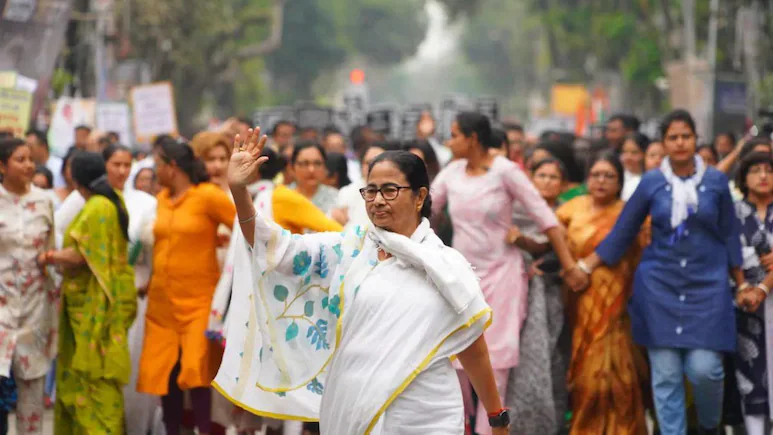
In over a decade of governance, Mamata Banerjee has reshaped the political and economic landscape of West Bengal — with women at the centre of that transformation.
What began as welfare-focused interventions has gradually evolved into a broader movement toward education, financial independence and political participation. Today, women in Bengal are not just voters — they are a decisive electoral force and an engine of grassroots economic growth.
From Welfare To Empowerment
One of the flagship initiatives, Kanyashree Prakalpa, has supported nearly 1 crore girls with financial assistance to continue their education and prevent early marriages. With expenditure crossing ₹16,000 crore, the scheme has been widely cited as a model for improving girls’ school retention, even drawing international recognition.
Similarly, the Rupashree Prakalpa provides ₹25,000 in financial aid to women from economically weaker families at the time of their marriage. Over 22 lakh women have benefited, with the state spending more than ₹5,500 crore under the programme. For many families, it has offered financial relief during a significant life event.
Economic Participation On The Rise
Beyond social welfare, women in Bengal are increasingly becoming entrepreneurs and job creators. The state ranks first nationally in women-owned MSMEs, accounting for over 23% of such enterprises across India. This shift signals a transition from dependency to self-driven economic participation.
Under Muktir Alo Yojana, vocational training has been provided to socially marginalised and distressed women, equipping thousands with employable skills. Meanwhile, the Lakshmi Bhandar scheme — which provides monthly financial assistance to women — has offered a safety net that strengthens household finances and boosts local spending power.
Political Impact
The impact of these programmes extends well beyond economics. Women’s voter turnout in panchayat, Assembly and Lok Sabha elections has surged, often outpacing male participation. Political observers say this growing engagement has translated into a solid and loyal support base for Banerjee.
By focusing on education, financial assistance, entrepreneurship and social security, her government has positioned women not merely as beneficiaries but as partners in development.
For many households across Bengal, these schemes represent more than policy announcements — they are tangible interventions that have improved access to education, income and dignity. And politically, that connection has proven to be one of Mamata Banerjee’s strongest pillars of support.
News Source : Information for this article was gathered from a variety of reliable news outlets.