

Centre Defends Waqf Law in Supreme Court, Says “It’s for Charity, Not Religion”
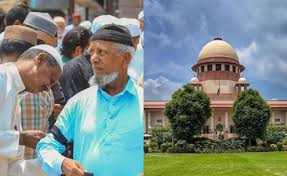
In a significant hearing before the Supreme Court, the Centre strongly defended the Waqf Amendment Act, insisting that Waqf is rooted in charity, not religion, and therefore not an essential or fundamental aspect of Islam.
Solicitor General Tushar Mehta, representing the government, clarified that while Waqf is undoubtedly an Islamic concept, it is not a constitutionally protected religious practice. “Waqf is for charity. A Waqf board carries out secular functions, and the law does not infringe upon religious freedoms guaranteed under Article 25,” Mr Mehta told the bench led by Chief Justice BR Gavai.
The legal challenge has emerged amidst concerns that the law enables the state to interfere in or even take over Waqf properties. Mr Mehta countered that narrative, asserting that the State’s responsibility is to safeguard public assets for all 140 crore citizens. “False fears are being spread — no one is being forced to surrender documents, and there’s no mass capture of Waqf lands,” he said.
Responding to criticism over the inclusion of non-Muslim members in Waqf boards, he asked, “If there are two non-Muslims, how does that affect anything? These boards are not involved in religious rituals.”
The Centre also took issue with the petitioners’ claim to speak for the entire Muslim community, highlighting the extensive consultative process that preceded the amendment — including 96 lakh representations and 36 meetings by the Joint Parliamentary Committee.
Addressing the controversy around ‘waqf by user’ — where land is claimed through continuous use — Mr Mehta clarified that the government merely wants to verify rightful ownership. “If a government building is being used as a Waqf, should the government not be allowed to verify its own property?” he asked.
The hearing also touched on the requirement that only a practising Muslim for at least five years can create a Waqf. Mr Mehta stated that even Shariat law outlines basic criteria for being recognised as a Muslim, though it doesn’t demand strict ritual observance.
In differentiating Hindu and Muslim endowments, he pointed out that Hindu religious bodies are subject to stricter control under state laws, such as the Bombay Public Trust Act and the Tamil Nadu Endowments Act — where even temple heads can be removed for misconduct. “Hindu endowments are only religious, while Waqfs include schools, orphanages, and hospitals,” he said.
He also clarified the administrative structure of Waqf institutions — distinguishing between the Sajjadanashin (religious leader) and the Mutawalli (manager), and stressed that the law pertains only to the latter.
To strengthen his case, Mr Mehta referenced the Hindu Code Bills of 1956, which restructured Hindu personal law. “Back then, no one asked why only Hindus were being addressed and not Muslims,” he said, arguing that reform and regulation aren’t a breach of religious freedom.
However, senior advocate Kapil Sibal, appearing for the petitioners, took a strong stand against the law. “This is about private property — mine — being taken by the State. The process laid out in the Act allows the government to act as judge in its own cause,” he argued.
He also pointed out the inequity in the requirement of proving five years of religious practice to create a Waqf. “If someone wants to dedicate their property on their deathbed, how do they prove they were a practising Muslim? It’s unconstitutional,” he said.
Sibal highlighted the financial disparities between mosques and temples, noting that while temples often receive substantial donations (chadhava), mosques rely on private contributions. “People donate land for Waqf because the State doesn’t fund mosques or burial grounds.”
The Supreme Court, while hearing both sides, noted that laws passed by Parliament carry a presumption of constitutionality unless a clear and glaring violation is demonstrated. The case continues, with wide-ranging implications for how religious and charitable trusts are managed across the country.
News Source : Information for this article was gathered from a variety of reliable news outlets.